
Why Is Your Child Slow at Math? How Mental Math Builds Speed & Confidence
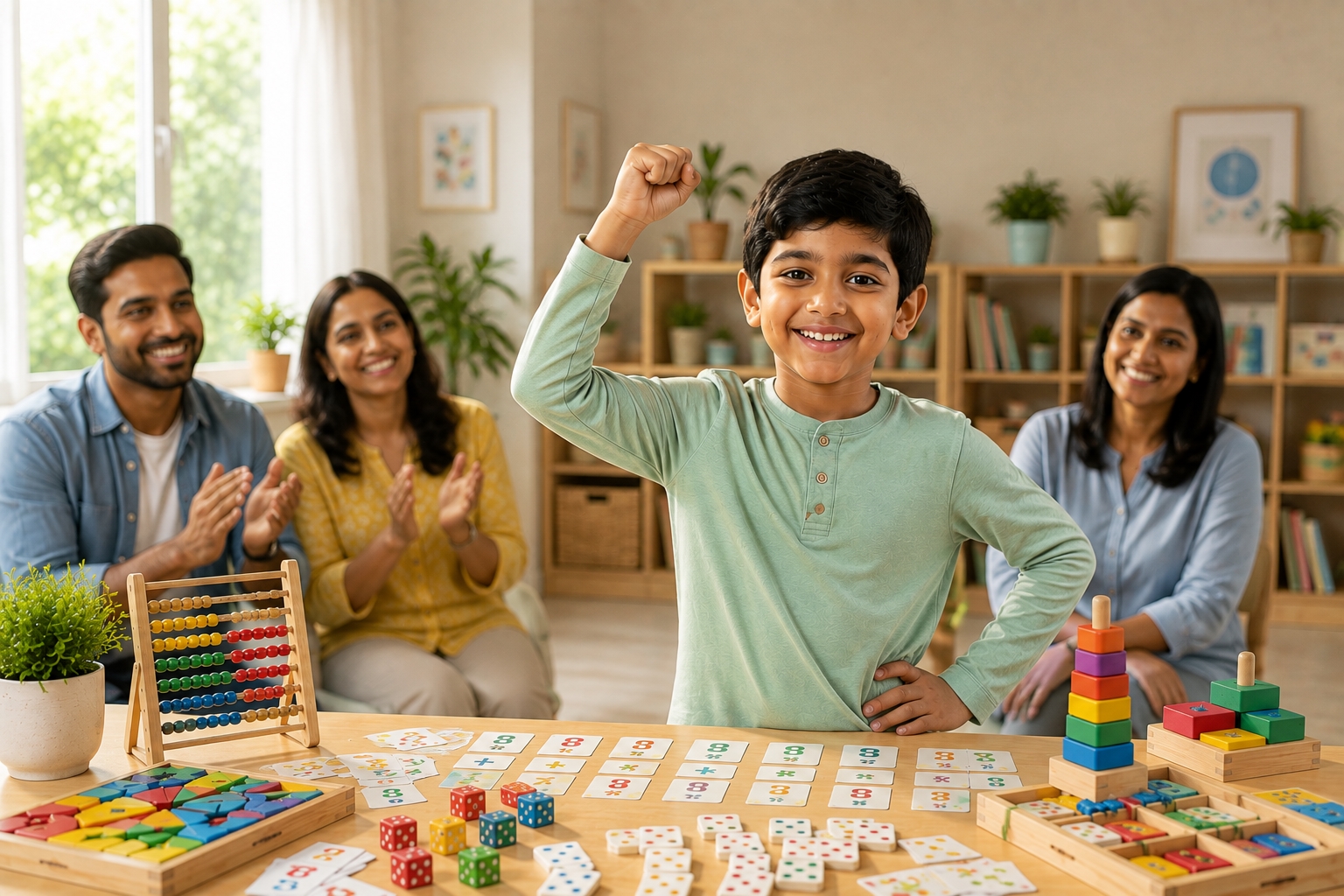
Is Your Child Taking Too Long to Solve Simple Math Problems?
Does your child still count on their fingers for 8 + 7?
Do they freeze when solving multiplication problems?
Do homework sessions end with frustration, tears, or "I hate math"?
If yes, you're not alone.
Many parents think their child is simply "bad at math." In reality, most children are not weak at math—they're weak at mental math.
Mental math is the ability to solve calculations in your head without depending on paper, calculators, or counting fingers.
Children with strong mental math skills don't just answer faster—they understand numbers better, make fewer mistakes, and become much more confident learners.
In this guide, you'll discover:
- Why children become slow at math
- How mental math improves speed and confidence
- Signs your child needs mental math practice
- Easy activities parents can try at home
What Is Mental Math?
Mental math is the ability to calculate numbers in your head using number sense, logic, and simple strategies instead of written methods or calculators.
Instead of memorizing steps, children learn how numbers work together.
For example,
Instead of solving:
48 + 29
Children mentally think:
48 + 30 = 78
78 − 1 = 77
This flexible thinking makes calculations much faster.
Why is my child slow at math?
Children are usually slow at math because they lack number fluency rather than intelligence. Weak mental math skills increase the load on working memory, making even simple calculations feel difficult. Regular mental math practice improves speed, confidence, concentration, and problem-solving.
7 Reasons Your Child Is Slow at Math
1. Weak Number Sense
Many children memorize answers without understanding numbers.
They know:
7 + 5 = 12
But don't understand that
7 + 3 + 2 = 12
Without number flexibility, every problem feels new.
Mental math builds this understanding naturally.
2. Too Much Finger Counting
Finger counting is normal in early learning.
But when children continue using fingers beyond Grade 2 or 3, calculations become slower.
Instead of instantly knowing
9 + 8
they count one finger at a time.
Mental math gradually replaces finger counting with quick recall.
3. Poor Math Fact Fluency
Imagine reading a story while sounding out every single letter.
That's exactly how math feels when children haven't mastered basic facts.
If your child pauses to calculate
6 × 7
every single time,
their brain has less space to solve the actual problem.
Mental math builds automatic recall.
4. Low Confidence
Many children actually know the answer.
They just don't trust themselves.
They constantly second-guess every calculation.
Confidence comes from repeated success.
Mental math gives children many small wins every day.
5. Working Memory Gets Overloaded
Mental math depends on working memory.
Children must remember numbers, perform calculations, and keep track of steps—all at once.
When basic math facts aren't automatic, working memory becomes overloaded.
The result?
- Slow calculations
- More mistakes
- Increased frustration
6. Overdependence on Calculators
Technology is useful.
But if calculators solve every problem, children's brains miss opportunities to build number sense.
Mental math strengthens thinking before technology takes over.
7. Math Anxiety
Many children become anxious after making repeated mistakes.
Once anxiety starts, the brain struggles to retrieve even simple facts.
Mental math practiced through games removes pressure and rebuilds confidence.

Why Mental Math Makes Children Faster
Mental math trains the brain to recognize patterns instead of calculating everything from scratch.
For example,
Instead of
49 + 28
Children think
50 + 28 = 78
78 − 1 = 77
Small strategies like these save time and reduce mistakes.
Over time, calculations become automatic.
Benefits of Mental Math for Children
1. Improves Number Sense
Children begin to understand relationships between numbers instead of memorizing formulas.
This helps them solve unfamiliar questions with confidence.
2. Builds Faster Thinking
Regular mental math practice improves processing speed.
Children answer classroom questions more quickly and complete homework faster.
3. Strengthens Memory
Mental calculations require children to remember numbers while solving problems.
This strengthens both short-term and long-term memory.
4. Improves Concentration
Mental math requires full attention.
Children learn to focus without becoming distracted.
These concentration skills also improve reading and science learning.
5. Develops Logical Thinking
Mental math teaches children to break problems into smaller, easier steps.
Instead of memorizing procedures, they learn to think logically.
6. Reduces Math Anxiety
As children experience success, their fear of math decreases.
Confidence replaces hesitation.
Soon, they begin volunteering answers in class instead of avoiding them.
7. Helps Beyond Mathematics
Mental math is useful every day.
Children use it while:
- Shopping
- Estimating time
- Sharing snacks
- Playing games
- Measuring ingredients
- Managing pocket money
These everyday experiences make learning meaningful.
Signs Your Child Needs Mental Math Practice
Your child may benefit from mental math if they:
- Count on fingers for simple sums
- Take a long time to finish homework
- Avoid answering math questions aloud
- Depend on calculators too early
- Forget multiplication tables easily
- Get anxious during math tests
- Struggle with estimation
- Lack confidence in class
If several of these sound familiar, mental math practice can make a significant difference.
Easy Mental Math Activities Parents Can Try at Home
Count While Walking
Ask your child to skip count by:
- 2s
- 5s
- 10s
- 25s
during walks or while climbing stairs.
Grocery Shopping Challenge
Ask:
"We bought apples for ₹48 and milk for ₹52. About how much did we spend?"
These quick questions make math practical.
Dice Games
Roll two dice.
Ask children to:
- Add
- Subtract
- Multiply
without writing anything down.
Number Card Race
Show flashcards for three seconds.
Children answer mentally before the card disappears.
Guess My Number
Give clues like:
"I'm greater than 40."
"I'm even."
"I'm divisible by 5."
Children guess the number while practicing logical thinking.
Cooking Together
Ask children:
"If we double this recipe, how much flour do we need?"
Cooking naturally develops multiplication and fractions.
Daily 10-Minute Challenge
Just 10 minutes of mental math every day can significantly improve speed and confidence over time.
Consistency matters more than long study sessions.

Mental Math by Age
| Age | Focus |
|---|---|
| 5–6 years | Counting, number recognition, simple addition |
| 6–7 years | Number bonds, subtraction, doubles |
| 7–8 years | Multiplication facts, estimation |
| 8–10 years | Mental multiplication and division |
| 10–12 years | Fractions, percentages, algebra readiness |
How ClassMonitor Makes Mental Math Fun
Children learn best when math feels like play.
Instead of endless worksheets, ClassMonitor combines learning with engaging, hands-on activities that keep children curious and motivated.
Our play-based approach helps children:
- Build strong number sense
- Improve calculation speed
- Develop logical thinking
- Strengthen memory and concentration
- Gain confidence through interactive challenges
By practicing regularly with educational games, puzzles, flashcards, and problem-solving activities, children naturally develop the mental math skills they need for school and everyday life.
Conclusion
If your child is slow at math, it doesn't mean they're not capable.
Most children simply need stronger number sense and regular mental math practice.
The good news is that mental math isn't about memorizing tricks or rushing through problems. It's about helping children understand numbers, think flexibly, and solve problems with confidence.
With just a few minutes of daily practice through games, conversations, and everyday activities, your child can become faster, more accurate, and far more confident in mathematics.
Remember, every confident mathematician starts with small mental steps.
Frequently Asked Questions
1. Why is my child slow at solving math problems?
Most children are slow because they lack number fluency and mental math practice, not because they are poor at math.
2. At what age should children start mental math?
Children can begin simple mental math activities around ages 5–6 using counting games, number bonds, and everyday calculations.
3. Does mental math improve school performance?
Yes. Mental math improves speed, accuracy, concentration, memory, and confidence, helping children perform better across many subjects.
4. Should children use calculators?
Calculators are useful for complex calculations, but young children should first develop strong mental math skills and number sense.
5. How much mental math practice is enough?
Around 10–15 minutes daily is enough to build long-term fluency without overwhelming children.
6. Can games improve mental math?
Absolutely. Dice games, card games, puzzles, shopping activities, cooking, and board games are excellent ways to practice mental math while keeping learning enjoyable.
7. How can parents encourage mental math at home?
Ask simple calculation questions during daily routines, play number games, encourage estimation, and celebrate effort rather than speed. These small habits help children build confidence and enjoy learning math.