
What Is Mental Math? Benefits Every Parent Should Know
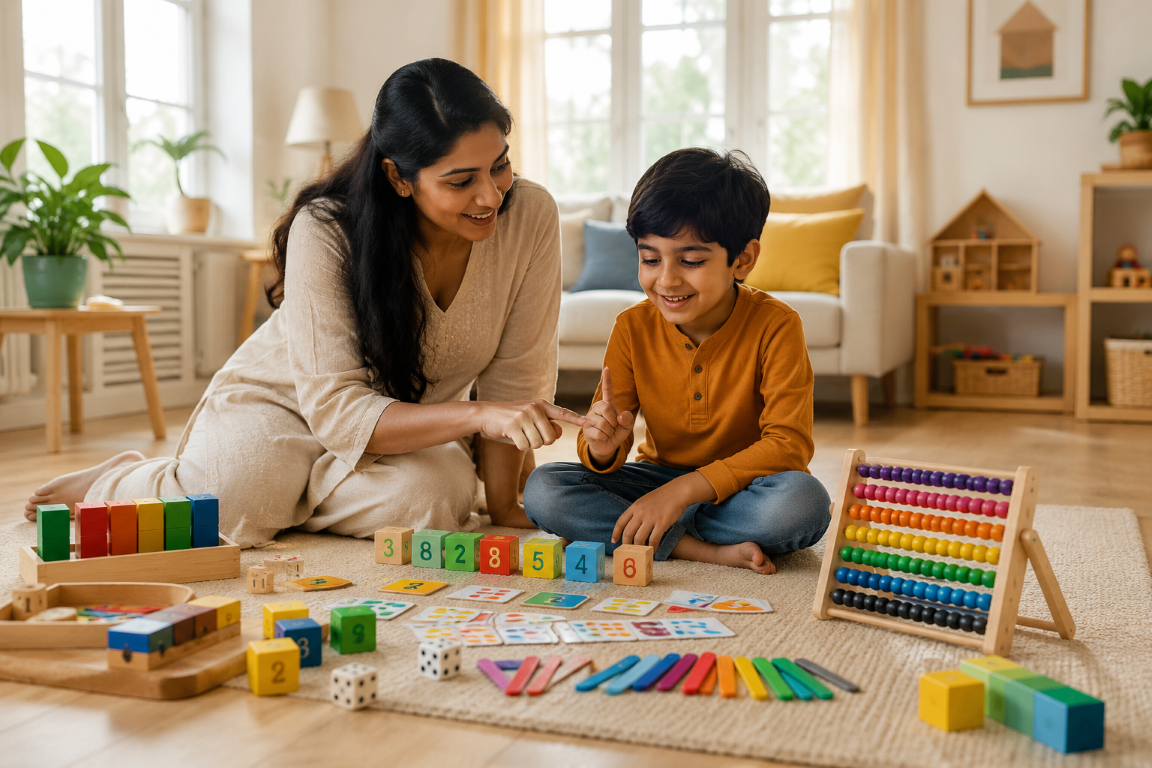
What Is Mental Math? Benefits Every Parent Should Know
Mental math is the ability to solve mathematical problems using your mind instead of paper, calculators, or other tools. It helps children improve number sense, logical thinking, memory, concentration, and problem-solving skills. Regular mental math practice through games and everyday activities builds confidence and creates a strong foundation for advanced mathematics.
What Is Mental Math? Benefits Every Parent Should Know
Mathematics isn't just about solving problems in a textbook. Children use math every day—while counting toys, sharing snacks, estimating time, shopping with parents, or playing board games. One of the most valuable skills that helps them handle these situations confidently is mental math.
Many parents think mental math simply means answering calculations quickly. In reality, it's much more than speed. Mental math teaches children to understand numbers, recognize patterns, and solve problems using logical thinking instead of memorization.
As technology becomes a bigger part of everyday life, calculators and smartphones are always within reach. However, children who develop strong mental math skills become more confident learners because they can think independently without relying on devices.
In this guide, you'll learn what mental math is, why it matters, how it benefits your child, and simple ways to encourage mental math naturally at home.
What Is Mental Math?
Mental math is the ability to perform mathematical calculations in your head without using paper, calculators, fingers, or other external tools.
Instead of memorizing answers, children learn to understand how numbers work. They break numbers into smaller parts, recognize patterns, estimate answers, and use logical strategies to solve problems quickly.
For example:
- Instead of calculating 49 + 26 digit by digit, a child may think:
- 50 + 25 = 75
- Adjust by adding 1 and subtracting 1
- Answer = 75
Similarly,
Instead of multiplying 25 × 4, children recognize that four groups of 25 equal 100.
Mental math develops flexibility with numbers, helping children think about different ways to reach the same answer.
Mental Math vs Memorization
Many parents confuse mental math with memorizing multiplication tables or formulas. While memorization has its place, true mental math focuses on understanding.
| Memorization | Mental Math |
| Learns answers by heart | Understands number relationships |
| Depends on repeated practice | Uses logical thinking |
| One fixed method | Multiple ways to solve a problem |
| Easy to forget | Builds long-term understanding |
| Focuses on speed | Focuses on accuracy and reasoning |
When children understand numbers instead of simply memorizing them, they become more confident and adaptable problem-solvers.
Why Is Mental Math Important for Children?
Mental math supports much more than classroom mathematics. It strengthens the brain, improves decision-making, and develops essential life skills that children use every day.
Children with strong mental math abilities often find it easier to:
- Learn new math concepts
- Solve word problems
- Estimate quickly
- Make decisions confidently
- Think logically under pressure
- Develop perseverance when solving challenges
Rather than depending on calculators, they trust their own thinking.

10 Benefits of Mental Math Every Parent Should Know
1. Builds Strong Number Sense
Number sense is a child's ability to understand numbers, their relationships, and how they work together.
Instead of seeing 48 as just a number, children recognize that it is:
- 40 + 8
- 50 − 2
- 6 × 8
This flexibility makes future math concepts much easier.
Children with strong number sense learn addition, subtraction, multiplication, fractions, decimals, and algebra more confidently.
2. Improves Problem-Solving Skills
Mental math teaches children that there is often more than one way to solve a problem.
For example:
Instead of calculating:
38 + 29
They may think:
38 + 30 = 68
68 − 1 = 67
Learning different strategies improves critical thinking and encourages children to explore multiple solutions instead of relying on one method.
3. Boosts Memory and Concentration
Mental calculations require children to remember numbers while solving problems.
For example:
To calculate:
75 − 28
Children mentally:
- Remember 75
- Subtract 20
- Keep track of the remaining value
- Subtract another 8
Repeated practice strengthens working memory and improves concentration, helping children in subjects beyond mathematics.
4. Increases Speed Without Sacrificing Accuracy
Children who understand numbers naturally solve problems faster.
This doesn't mean rushing.
Instead, mental math helps children:
- Recognize shortcuts
- Avoid unnecessary steps
- Estimate answers
- Check calculations mentally
This becomes especially useful during school assessments where time management matters.
5. Builds Confidence in Mathematics
Many children develop math anxiety because they believe every problem is difficult.
Mental math changes this mindset.
When children successfully solve everyday calculations on their own, they begin believing:
"I can do this."
This confidence encourages them to participate more actively in class and approach challenging problems without fear.
6. Encourages Logical Thinking
Mental math isn't about guessing answers.
Children learn to:
- Compare numbers
- Identify patterns
- Predict outcomes
- Choose the most efficient strategy
These logical thinking skills benefit science, coding, engineering, puzzles, and everyday decision-making.
7. Makes Everyday Life Easier
Mental math appears everywhere.
Children naturally use it when they:
- Count toys
- Divide snacks among friends
- Estimate grocery costs
- Measure ingredients while cooking
- Tell time
- Save pocket money
- Calculate scores during games
Practicing these real-life situations helps children understand why mathematics matters beyond school.
8. Reduces Dependence on Calculators
Technology is helpful, but children shouldn't rely on calculators for every simple calculation.
Strong mental math skills allow children to:
- Estimate before calculating
- Check calculator answers
- Spot obvious mistakes
- Feel confident without digital devices
This independence becomes valuable throughout school and adulthood.
9. Strengthens Brain Development
Mental math activates different parts of the brain responsible for:
- Memory
- Attention
- Logical reasoning
- Decision-making
- Visualization
Regular practice creates stronger neural connections, improving overall cognitive development.
Because mental math combines memory, reasoning, and visualization, it exercises the brain much like physical activity strengthens muscles.
10. Creates a Positive Attitude Toward Learning
Children who enjoy solving number puzzles begin viewing mathematics as a fun challenge rather than a difficult subject.
Instead of asking,
"Do I have to practice math?"
they begin asking,
"Can we play another number game?"
This positive mindset encourages lifelong learning.
Signs Your Child Is Developing Good Mental Math Skills
You may notice your child:
- Solves simple calculations without counting on fingers
- Recognizes number patterns quickly
- Estimates answers before calculating
- Uses different strategies to solve the same problem
- Explains how they found an answer
- Enjoys number games and puzzles
- Makes fewer calculation mistakes over time
- Shows confidence during math activities
These are strong indicators that your child's number sense is developing well.

8 Easy Mental Math Activities Parents Can Try at Home
Children learn best through play. These simple activities require little or no preparation and naturally strengthen mental math skills.
1. Count Everything
Ask your child to count everyday objects like spoons, books, shoes, or toys.
Challenge them further by asking:
- "How many more do we need to make ten?"
- "What if we remove three?"
This develops number sense naturally.
2. Grocery Store Math
While shopping, ask questions like:
- Which item costs more?
- If two fruits cost $4 each, how much will they cost together?
- We have $20. How much money will remain?
Children quickly understand that math is useful in everyday life.
3. Dice Addition Challenge
Roll two or three dice.
Ask your child to:
- Add the numbers
- Find the biggest number
- Double one number
- Subtract the smaller number from the larger one
This improves quick thinking while feeling like a game.
4. Cooking Together
Cooking introduces practical mathematics through:
- Measuring ingredients
- Doubling recipes
- Halving quantities
- Understanding fractions
Children learn without realizing they're practicing math.
5. Number Treasure Hunt
Hide number cards around the house.
Ask children to:
- Arrange numbers from smallest to largest.
- Find even numbers.
- Find odd numbers.
- Make addition or subtraction problems using the cards.
Adding movement keeps learning exciting.
6. Card Games
A simple deck of playing cards can become a powerful learning tool.
Ask your child to:
- Add two cards.
- Multiply card values.
- Find the difference between numbers.
- Build the largest possible number using selected cards.
7. Estimation Games
Instead of always calculating exact answers, encourage your child to estimate.
Ask questions like:
- How many pencils are in the jar?
- About how many pages are in this book?
- Which basket has more apples?
Estimation builds number intuition.
8. Family Math Time
Spend just ten minutes each evening solving number puzzles together.
You might play:
- Mental math quizzes
- Number riddles
- Board games
- Math bingo
- Pattern challenges
When parents participate, children stay motivated and develop a positive attitude toward learning.
Common Mistakes Parents Should Avoid
Parents often have the best intentions, but certain habits can make children feel anxious about mathematics.
1. Focusing Only on Speed
Mental math is about understanding numbers—not racing to finish first.
Encourage your child to explain their thinking instead of only giving the correct answer.
2. Comparing Children
Every child learns differently.
Avoid comparisons like:
"Your friend already knows multiplication."
Instead, celebrate your child's personal progress.
3. Depending Too Much on Worksheets
Worksheets help reinforce learning, but children understand concepts better through hands-on activities and real-life experiences.
4. Correcting Every Mistake Immediately
Mistakes help children learn.
Ask questions like:
"What made you choose that answer?"
This encourages reflection and independent thinking.
5. Making Math Feel Like a Chore
Long practice sessions often reduce motivation.
Short, enjoyable activities completed consistently are far more effective.
How ClassMonitor Makes Mental Math Fun
At ClassMonitor, we believe children learn mathematics best when they actively explore, play, and discover.
Our play-based learning approach combines:
- Hands-on math activities
- Interactive puzzles
- Number games
- Flashcards
- Brain-building challenges
- Everyday learning experiences
Rather than encouraging children to memorize answers, we help them understand how numbers work through meaningful experiences. This builds confidence, strengthens logical thinking, and develops lifelong problem-solving skills.
By making math enjoyable, children become curious learners who are eager to explore new concepts instead of fearing them.
Frequently Asked Questions
What is mental math?
Mental math is the ability to solve mathematical calculations in your head without using paper, calculators, or other tools. It helps children develop number sense, logical thinking, and confidence.
At what age should children start practicing mental math?
Children can begin simple mental math activities as early as 3–4 years old through counting games, number recognition, sorting, and everyday conversations involving numbers.
How much time should children practice mental math?
Just 10–15 minutes of daily practice is enough to improve calculation skills, memory, and confidence over time.
Is mental math only useful for school exams?
No. Mental math helps children solve everyday problems such as shopping, budgeting, cooking, telling time, estimating distances, and making quick decisions.
Can games really improve mental math?
Yes. Games encourage children to think, estimate, compare numbers, recognize patterns, and solve problems naturally, making learning more engaging than repetitive worksheets alone.
Does mental math replace calculators?
No. Calculators are useful tools, but strong mental math skills help children estimate answers, identify calculation errors, and become independent thinkers.
Conclusion
Mental math is much more than solving calculations quickly—it is about helping children understand numbers, think logically, and approach challenges with confidence. From counting toys and estimating grocery bills to solving puzzles and playing games, every small experience strengthens a child's mathematical thinking. By encouraging regular, play-based practice instead of rote memorization, parents can help children build strong number sense, improve concentration, and develop lifelong problem-solving skills. With engaging activities and the right learning environment, mental math becomes less about getting the right answer and more about developing the confidence to explore, reason, and enjoy mathematics every day.