
Spell Bee Preparation Tips for Kids: Easy Guide for Parents
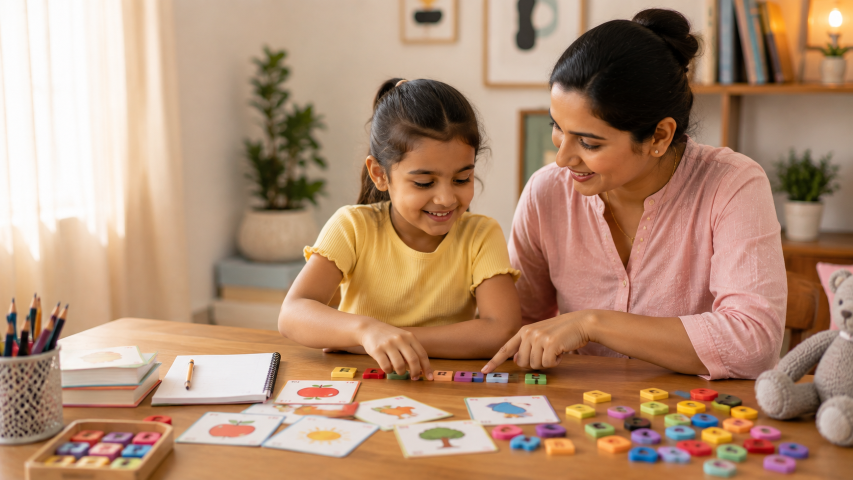
Spell Bee Preparation Tips for Kids: A Simple Guide for Parents
Preparing for a Spell Bee is not just about memorizing hundreds of difficult words. Children also need to understand sounds, spelling patterns, word meanings, word roots, and common spelling rules.
With the right practice routine, parents can make Spell Bee preparation enjoyable instead of stressful. Short, regular practice sessions can help children become better spellers while also strengthening their vocabulary, reading, writing, and confidence.
In this guide, we’ll explore easy Spell Bee preparation tips for kids, fun practice activities, common mistakes to avoid, and a simple daily routine parents can follow at home.
What Is a Spell Bee?
A Spell Bee is a competition in which children are asked to spell words correctly, usually by hearing them and spelling them aloud.
Depending on the competition, children may also need to understand a word's meaning, pronunciation, origin, or usage before spelling it.
For younger children, Spell Bee preparation can be especially useful because spelling practice connects several early literacy skills, including phonemic awareness, phonics, vocabulary, reading, and writing.
How Can Kids Prepare for a Spell Bee?
The best way to prepare for a Spell Bee is to combine regular word practice with phonics, spelling patterns, vocabulary, and active recall.
Instead of asking children to repeatedly copy the same word, try this simple approach:
- Learn the word.
- Say the word aloud.
- Break it into sounds or parts.
- Look for its spelling pattern.
- Understand its meaning.
- Cover the word and spell it from memory.
- Write the word.
- Use it in a sentence.
- Review it again later.
This approach turns spelling practice into an active learning experience rather than simple memorization.

10 Spell Bee Preparation Tips for Kids
1. Start With Words at the Right Level
One common mistake parents make is beginning with extremely difficult words.
Start with words appropriate for your child's age and current spelling ability. Once your child becomes comfortable, gradually introduce longer and more challenging words.
For example:
Beginner:
cat, jump, school, friend, garden
Intermediate:
beautiful, important, exciting, different, carefully
Advanced:
environment, extraordinary, responsibility, pronunciation, imagination
The goal is to create a steady progression from familiar → challenging → unfamiliar words.
A child who feels successful during practice is more likely to stay motivated.
2. Teach Phonics Along With Spelling
Phonics can give children a useful foundation for spelling because it helps them connect letters with sounds.
For example:
ship → sh + i + p
train → tr + ai + n
bright → br + igh + t
Rather than asking children to memorize every word as a picture, encourage them to listen carefully to the sounds and notice how those sounds are represented by letters.
Research-based literacy guidance supports systematic phonics instruction for developing reading and spelling skills.
Try this at home:
Say a word such as “sunshine.”
Ask:
- How many parts can you hear?
- What sound does the word begin with?
- What letters represent that sound?
- Can you break the word into smaller parts?
This makes spelling more understandable and less dependent on rote memorization.
3. Teach Spelling Patterns, Not Just Individual Words
English spelling becomes easier when children begin noticing patterns.
Instead of teaching:
light, night, right, sight
as four completely unrelated words, point out the shared -ight pattern.
Similarly:
play, stay, day, tray
can help children notice the -ay pattern.
Create small word families and ask your child to find another word that follows the same pattern.
Quick game:
Write:
cake → make → lake → ____
Let your child find another word.
This develops pattern recognition while keeping practice playful.
Spelling instruction can involve letter-sound relationships, spelling patterns, word structure, and meaning rather than memorizing isolated words alone.
4. Make Your Child Understand the Word
A child may be able to memorize a spelling without actually knowing what the word means.
That is why vocabulary should be part of Spell Bee preparation.
For every new word, ask your child to learn:
Word: Curious
Meaning: Wanting to know or learn something
Sentence: The curious child asked many questions.
Related word: Curiosity
Understanding a word gives children more than one memory connection.
It also makes spelling practice useful beyond the competition.
5. Break Difficult Words Into Smaller Parts
Long words can look intimidating.
Instead of asking your child to memorize:
uncomfortable
break it into manageable parts:
un + comfort + able
Similarly:
dis + agree + ment
help + ful
care + less
Teaching children to notice meaningful parts such as prefixes, roots, and suffixes can support vocabulary and spelling development. Research on morphological instruction has found benefits for literacy skills, including spelling and vocabulary.
Parent tip:
When your child encounters a difficult word, ask:
“Can we find any smaller words or parts inside it?”
This simple question encourages children to investigate the word instead of immediately trying to memorize it.
6. Use the “Look, Say, Cover, Spell, Check” Method
This is a simple technique parents can use for daily Spell Bee practice.
Step 1: Look
Ask your child to look carefully at the word.
Step 2: Say
Say the word aloud together.
Step 3: Cover
Hide the word.
Step 4: Spell
Ask your child to spell it without looking.
Step 5: Check
Reveal the word and compare.
If there is a mistake, don't simply say, “Wrong.”
Ask:
“Which part of the word was tricky?”
Then practice that part again.
This turns mistakes into learning opportunities.
7. Practice Spelling Through Games
Spell Bee practice does not have to mean sitting at a table with a notebook every day.
Try simple games such as:
🧩 Word Scramble
Mix up the letters and let your child rearrange them.
🔤 Missing Letter
Write:
BEAUTI_UL
Ask your child to find the missing letter.
🎯 Spell It Fast
Give your child one minute to correctly spell as many familiar words as possible.
🕵️ Word Detective
Give clues about a word and ask your child to identify and spell it.
🧠 Memory Challenge
Show five words for 30 seconds. Hide them and ask your child to spell as many as possible.
🎲 Family Spell Bee
Take turns choosing words and challenging one another.
Games add repetition without making repetition feel boring.
8. Create a Personal “Difficult Words” List
Every child struggles with different words.
Instead of making your child repeatedly practice words they already know, create a personal Spell Bee mistake list.
For example:
| Word | What Was Difficult? |
| beautiful | vowel order |
| necessary | double consonant |
| separate | middle letters |
| receive | vowel pattern |
| tomorrow | repeated letters |
Review this list regularly.
A small list of words your child actually struggles with is often more useful than repeatedly revising a huge list of words they already know.
9. Use Writing to Strengthen Spelling
Spelling shouldn't be separated completely from writing.
Ask your child to use new Spell Bee words in:
- Short sentences
- Stories
- Journal entries
- Captions
- Descriptions
- Word puzzles
For example, after learning “adventure,” ask:
“Write one sentence about an adventure you would like to have.”
This helps connect spelling with meaning and real language use.
Spelling and reading rely on several overlapping skills, including phonemic awareness, knowledge of letter patterns, morphology, and word meaning.
10. Practice Speaking and Spelling Aloud
A Spell Bee is usually an oral performance, so children should not practice only by writing words.
Parents can conduct short mock rounds.
Say:
“Your word is adventure.”
The child can respond:
“Adventure. A-D-V-E-N-T-U-R-E. Adventure.”
Gradually teach children to stay calm, listen carefully, and spell at a comfortable pace.
Mock Spell Bee sessions can help children become familiar with the experience of hearing a word and responding aloud.
A Simple 15-Minute Spell Bee Practice Routine
You don't need to spend an hour every day preparing for a Spell Bee.
Try this 15-minute routine:
Minutes 1–3: Review
Revise 5–10 previously learned words.
Minutes 4–6: Learn
Introduce 3–5 new words.
Minutes 7–9: Word Detective
Explore sounds, spelling patterns, syllables, prefixes, suffixes, or word meanings.
Minutes 10–12: Active Recall
Hide the words and ask your child to spell them.
Minutes 13–15: Mini Spell Bee
Conduct a quick oral spelling round.
Keep the session short enough that your child can stay focused.
Consistency is more useful than forcing long practice sessions once in a while.
How Many Words Should a Child Practice Every Day?
There is no single number that works for every child.
For younger children, 5–10 carefully selected words can be enough for one practice session.
Older or more advanced children may be able to work with more words.
The important factor is not simply the number of words practiced. It is whether your child can:
- Recognize the word
- Pronounce it
- Understand its meaning
- Notice its spelling pattern
- Spell it independently
- Remember it after some time
Quality practice matters more than racing through a large word list.

What Should Kids Learn for a Spell Bee?
A strong Spell Bee preparation plan can include these areas:
1. Phonics
Letter-sound relationships and common sound patterns.
2. Spelling Patterns
Common combinations such as -tion, -ight, -ough, -ment, -able.
3. Syllables
Breaking longer words into manageable parts.
4. Word Families
Words that share similar spelling patterns.
5. Vocabulary
Knowing what words mean and how they are used.
6. Word Roots
Recognizing meaningful parts of longer words.
7. Prefixes and Suffixes
Examples include un-, re-, -ful, -less, -ment.
8. Irregular Words
Words whose spelling cannot always be predicted easily from pronunciation.
This broader approach helps children understand why words are spelled in particular ways.
Common Spell Bee Mistakes Parents Should Avoid
Making Children Memorize Everything
Memorization has a role, especially for irregular words, but it shouldn't be the entire strategy.
Practicing for Too Long
Long sessions can cause frustration and reduce attention.
Correcting Every Mistake Harshly
Mistakes are useful clues about what the child needs to learn next.
Introducing Words That Are Too Difficult
Difficulty should increase gradually.
Ignoring Word Meaning
A child should ideally know more about a word than its letters.
Practicing Only on Paper
Include speaking, listening, games, reading, and writing.
Turning Preparation Into Pressure
The purpose of preparation is not only to win.
Children should also develop confidence, vocabulary, language awareness, and a positive attitude toward learning.
How Can Parents Make Spell Bee Preparation Fun?
Try connecting spelling with your child's interests.
If your child likes animals, practice words such as:
elephant, butterfly, crocodile, penguin
If your child loves space:
planet, astronaut, telescope, galaxy
If your child enjoys stories:
character, adventure, magical, wonderful
You can also put new words around the house, create word cards, play family spelling challenges, or let your child become the “teacher” and quiz you.
When children actively participate in learning, spelling practice can feel more like a game than homework.
Spell Bee Preparation: A Parent's Checklist
Before the competition, ask yourself:
☐ Is my child comfortable with age-appropriate spelling words?
☐ Can my child recognize common spelling patterns?
☐ Can they break longer words into smaller parts?
☐ Do they understand the meanings of the words they practice?
☐ Are they practicing both orally and in writing?
☐ Do they have a list of commonly misspelled words?
☐ Have we conducted short mock Spell Bee rounds?
☐ Are practice sessions short and consistent?
☐ Does my child feel encouraged rather than pressured?
If most answers are “yes,” your child is building a strong foundation for Spell Bee preparation.
Frequently Asked Questions
1. How can I prepare my child for a Spell Bee at home?
Create a short daily routine that combines word reading, pronunciation, phonics, spelling patterns, vocabulary, writing, and oral spelling practice. Start with manageable words and gradually increase the difficulty.
2. How many words should my child learn for a Spell Bee?
There is no universal number. Start with a manageable group of words and focus on mastery rather than memorizing a large list. Review difficult words repeatedly over several days.
For formal competitions, always follow the organizer's official study list and rules. For example, the Scripps National Spelling Bee provides an official study resource called Words of the Champions for participating students.
3. What is the best way to remember difficult spellings?
Use multiple connections: say the word, break it into parts, identify its spelling pattern, understand its meaning, write it, spell it from memory, and review it later.
4. Does phonics help with Spell Bee preparation?
Yes. Phonics helps children understand relationships between sounds and letters, which can support spelling as well as reading. Systematic phonics instruction has been associated with improved spelling outcomes, particularly in the early grades.
5. Should children memorize spelling words?
Some memorization is useful, particularly for words with unusual or irregular spellings. However, children should also learn spelling patterns, sounds, word structure, and meanings so they can apply what they know to new words.
6. How can I improve my child's spelling quickly?
Rather than looking for a shortcut, establish a consistent short practice routine. Focus on a small number of words, identify mistakes, teach the underlying pattern, and review the words over time.
7. What should I do if my child keeps making the same spelling mistake?
Find the specific part causing difficulty. It could be a sound, vowel pattern, double letter, syllable, prefix, suffix, or irregular spelling. Practice that feature separately and then return to the complete word.
Final Thoughts: Make Spell Bee Preparation a Learning Journey
Preparing for a Spell Bee is about much more than winning a competition.
Every new word your child learns can become an opportunity to build spelling, vocabulary, reading, writing, pronunciation, and confidence.
The most effective approach is simple:
Learn → Understand → Practice → Recall → Review → Use
Keep practice short. Make it interactive. Celebrate improvement. And don't treat mistakes as failures—they show you exactly what your child needs to practice next.
With consistent support and playful learning, Spell Bee preparation can become an enjoyable part of your child's everyday learning journey.
Make Learning More Hands-On With ClassMonitor
At ClassMonitor, we believe children learn best when learning feels active, engaging, and age-appropriate. Hands-on activities, word games, puzzles, phonics practice, and interactive learning resources can complement a child's regular reading and spelling practice.
Instead of asking children to simply memorize more words, give them opportunities to see, hear, say, build, write, play, and use new words.
Because strong spelling skills are not built in one night—they grow one word, one pattern, and one practice session at a time.