
Spell Bee Preparation at Home: A Simple 15-Minute Daily Routine
Spell Bee Preparation
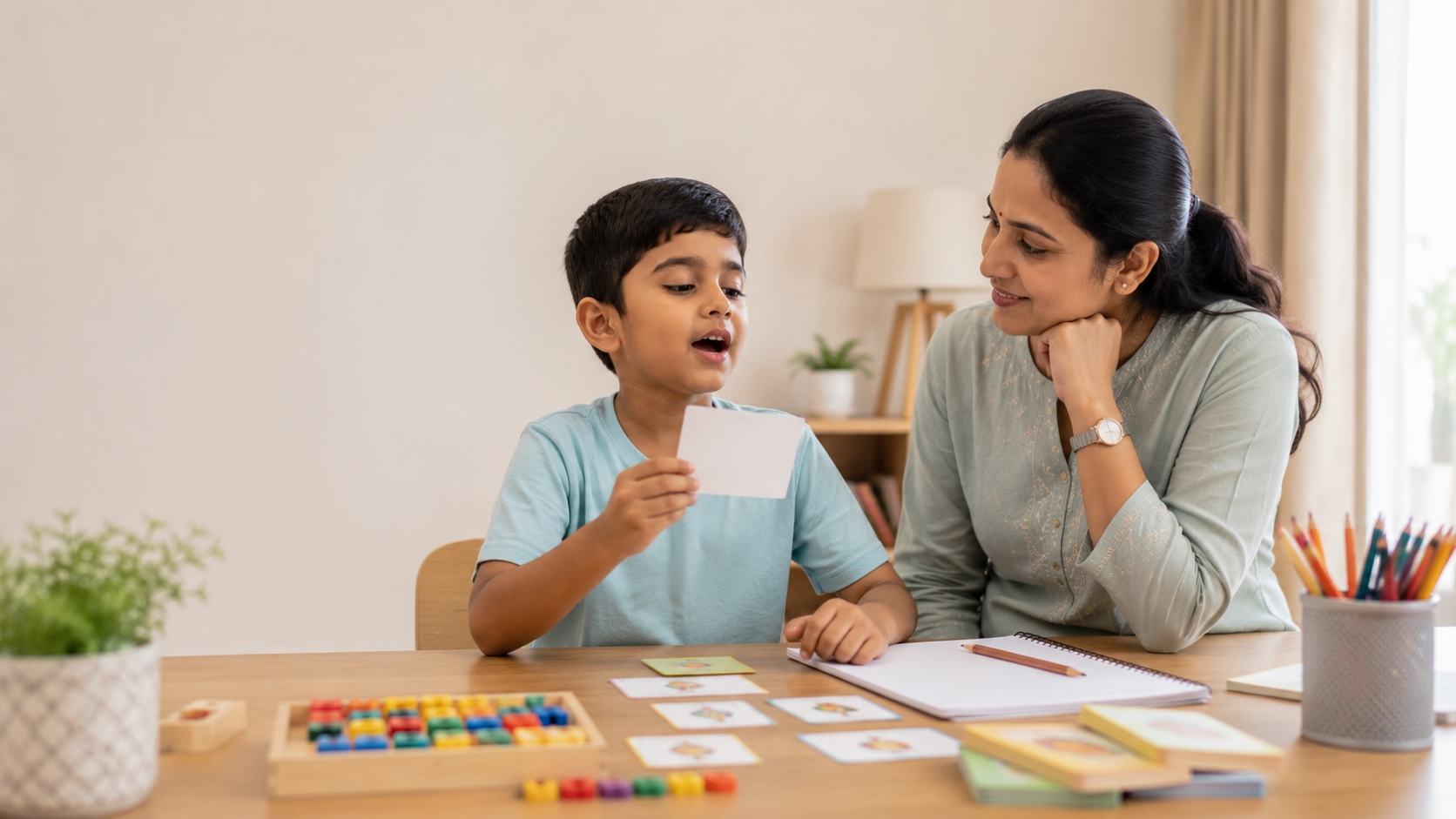
Want to prepare your child for a Spell Bee without turning evenings into long study sessions? A focused 15-minute daily routine can help. The key is to combine phonics, word patterns, vocabulary, active spelling practice and quick revision instead of asking children to memorise long lists of words.
For younger learners especially, spelling becomes easier when children understand how sounds, letters and word patterns work. Research reviewed by the National Reading Panel found that systematic phonics instruction supports children's ability to decode and spell words, while phonemic-awareness instruction can also improve spelling development.
A Spell Bee is not only about remembering difficult words. It is also about understanding words, recognising patterns, listening carefully and spelling confidently under pressure.
The good news? Parents can build these skills at home in just 15 minutes a day.
What Is the Best Way to Prepare for a Spell Bee at Home?
The best approach is short, consistent and active practice.
Instead of spending an hour making your child memorise spellings, divide 15 minutes into small activities:
| Time | Activity | Skill |
| 3 minutes | Sound & phonics warm-up | Letter-sound connection |
| 4 minutes | Learn 3–5 new words | Spelling patterns |
| 3 minutes | Say, spell and use | Vocabulary + recall |
| 3 minutes | Quick spelling challenge | Accuracy |
| 2 minutes | Revision game | Memory + confidence |
The goal is not to learn the maximum number of words every day. The goal is to learn a small number of words well.
Why a 15-Minute Routine Works Better Than Cramming
Children can easily lose interest when spelling practice feels like a long homework session.
A short routine gives them a predictable learning rhythm while allowing parents to practise consistently.
For example, learning five words every day gives a child 35 word-learning opportunities in a week. But the number of words should always be adjusted to the child's age, current spelling level and competition requirements.
The Scripps National Spelling Bee itself recommends progressively working through appropriate study resources rather than simply relying on random competition words. For school-level preparation, its current guidance points students toward the School Spelling Bee Study List, while students advancing beyond school-level competitions can use Words of the Champions.
For your child's school or local Spell Bee, however, always start with the official word list or syllabus provided by the school or organiser.
The 15-Minute Daily Spell Bee Routine
Minute 1–3: Start With Sounds
Don't begin with memorisation.
Start by asking your child to listen to and break down a word.
For example:
ship → sh + i + p
train → tr + ai + n
bright → br + igh + t
Ask:
- What sounds can you hear?
- Which letters represent those sounds?
- Is there a familiar spelling pattern?
- Can you think of another word with the same pattern?
This makes spelling more meaningful than simply copying letters.
Phonics instruction specifically connects letters with sounds and can be used to support both reading and spelling.
Parent Tip
If your child spells a word incorrectly, don't immediately say, "Wrong."
Instead ask:
"Let's listen to the word again. Which sound do we need to check?"
This encourages children to think about their spelling.

Minute 4–7: Learn 3–5 Spell Bee Words
Choose 3–5 words appropriate for your child's level.
Don't just show the spelling.
Teach each word using a simple four-step method:
Look → Say → Cover → Spell
1. Look:
Let your child look carefully at the word.
2. Say:
Say the word aloud and discuss its meaning.
3. Cover:
Hide the word.
4. Spell:
Ask your child to spell it aloud or write it.
For example:
Beautiful
Ask:
"What does beautiful mean?"
Then:
"Can you say it slowly?"
Then:
"Now spell it without looking."
This combines spelling with vocabulary rather than treating the word as a meaningless sequence of letters.
Minute 8–10: Make Your Child Use the Word
Knowing how to spell a word is useful, but understanding it makes the learning stronger.
For every new word, ask your child to do one quick vocabulary activity.
Try these:
Define it:
"What does curious mean?"
Use it:
"Can you make a sentence with curious?"
Find a synonym:
"What is another word for happy?"
Find an opposite:
"What is the opposite of ancient?"
Make a connection:
"Where might you hear or use this word?"
Vocabulary practice is valuable because spelling and word knowledge develop alongside broader language and literacy skills. The National Reading Panel identified vocabulary instruction as an important component of reading development.
Minute 11–13: Do a Mini Spell Bee
Now make the practice feel like the real thing.
Sit across from your child and become the "pronouncer."
Say:
"Your word is: elephant."
Let your child ask:
"Can you repeat the word?"
"What does it mean?"
"Can you use it in a sentence?"
Then let them spell it.
This is an excellent way to practise listening, recall and speaking confidence.
You can gradually introduce more realistic conditions:
- Stand up while spelling.
- Speak clearly into a pretend microphone.
- Give one word at a time.
- Don't show the written word.
- Ask the child to repeat the word before spelling.
- Celebrate correct answers.
- Correct mistakes calmly.
The official Scripps National Spelling Bee resources also emphasise preparing students for the competition format and rules, so practising the experience—not just the word list—can be useful.
Minute 14–15: Finish With a Fun Revision Game
End on a positive note.
Try one of these 2-minute spelling games.
1. Missing Letter
Write:
BEA_TIFUL
Ask:
"Which letter is missing?"
2. Scrambled Word
Write:
P L A P E
Can your child make APPLE?
3. Spell It Backwards
For an easy word, challenge your child to spell it backwards.
4. Word Detective
Ask:
"Find a word with -tion in your reading book."
5. Beat the Clock
Give your child 30 seconds to spell three familiar words correctly.
The purpose isn't to create pressure. It is to make revision enjoyable enough that your child wants to practise again tomorrow.
7-Day Spell Bee Practice Plan
Once your child is comfortable with the 15-minute routine, give each day a slightly different focus.
| Day | Focus | Example Activity |
| Monday | Phonics | Break words into sounds |
| Tuesday | Word patterns | Group words with similar endings |
| Wednesday | Vocabulary | Define and use new words |
| Thursday | Difficult spellings | Practise tricky words |
| Friday | Mixed revision | Review the week's words |
| Saturday | Mini Spell Bee | 10-word practice round |
| Sunday | Light revision | Word game + reading |
This keeps practice varied and prevents the routine from becoming repetitive.
How Many Words Should a Child Learn Every Day?
There is no single number that works for every child.
For younger learners, 3–5 well-practised words can be more useful than a large list that they quickly forget.
As your child becomes more confident, you can gradually increase the number.
A simple progression could be:
- Beginner: 3 words a day
- Developing: 5 words a day
- Confident: 5–10 words a day
- Advanced preparation: Follow the official competition study list and your child's school guidance
The Scripps National Spelling Bee currently recommends its School Spelling Bee Study List for school-level preparation and Words of the Champions for students preparing beyond the school level.
Quality of practice matters more than simply counting words.
Should Children Memorise Spell Bee Words?
Yes, but memorisation should not be the only strategy.
Some English spellings are irregular and need to be remembered. However, children can often make unfamiliar words easier by understanding:
- phonics
- common spelling patterns
- prefixes
- suffixes
- syllables
- word families
- word origins
- pronunciation
- meaning
For example, instead of memorising several words separately, help children notice patterns:
happy → happiness
kind → kindness
care → careful → carefully
This helps children see how words are connected.

What If My Child Keeps Making the Same Spelling Mistakes?
Don't simply make your child rewrite the word ten times.
First identify what kind of mistake they are making.
If they confuse sounds:
Practise phonics and sound segmentation.
If they miss letters:
Try "look, cover, spell, check."
If they confuse similar words:
Teach the meaning and usage.
If they forget word endings:
Practise suffixes such as -ing, -ed, -er, -est, -ly.
If they make random guesses:
Ask them to slow down and break the word into parts.
Most importantly, keep a small "My Tricky Words" list.
Every evening, revise two or three words from this list before introducing new ones.
5 Common Mistakes Parents Should Avoid During Spell Bee Preparation
1. Making Children Memorise Huge Lists
A long list can feel overwhelming.
Start small and increase gradually.
2. Correcting Every Mistake Immediately
Give your child time to think.
Ask questions that help them discover the mistake.
3. Ignoring Word Meaning
A child may remember letters temporarily but forget them quickly if the word has no meaning or context.
4. Practising Only by Writing
Spell Bees are usually spoken competitions, so children should also practise hearing, saying and spelling words aloud.
5. Turning Practice Into Pressure
A Spell Bee should challenge children without making them afraid of mistakes.
Confidence grows when children experience small, regular successes.
How Can Parents Make Spell Bee Preparation Fun?
Think beyond worksheets.
Try incorporating spelling into everyday activities:
During Reading
Ask your child to find five interesting words.
During Cooking
Spell ingredient names together.
During Shopping
Ask your child to read and spell product names.
During Car Rides
Play "word of the day."
During Family Time
Have a 5-word family spelling challenge.
With Flashcards
Show the word, hide it and ask your child to spell it.
With Games
Use puzzles, letter tiles, word-building games and vocabulary cards.
When children encounter words repeatedly in different contexts, spelling practice feels less like studying and more like discovering how language works.
A Simple Spell Bee Checklist for Parents
Before your child's Spell Bee, check whether they can:
- Spell age-appropriate words accurately.
- Recognise common spelling patterns.
- Break words into sounds or syllables.
- Explain the meaning of familiar competition words.
- Use new words in simple sentences.
- Listen carefully to a word.
- Ask for the word to be repeated when needed.
- Spell words aloud confidently.
- Recover calmly after making a mistake.
- Practise regularly without feeling overwhelmed.
Remember: the objective isn't just to win a Spell Bee. It is to build a child who enjoys words, reads confidently and understands how language works.
Frequently Asked Questions
1. How can I prepare my child for a Spell Bee at home?
Start with a short, consistent routine. Spend around 15 minutes combining phonics, 3–5 new words, vocabulary practice, oral spelling and quick revision. Use your child's official school or competition word list whenever one is provided.
2. How many words should my child learn for a Spell Bee?
It depends on the child's age, level and competition. For younger learners, begin with 3–5 words per day and increase gradually. For formal competitions, follow the study list provided by the organiser.
3. How can I improve my child's spelling quickly?
Focus on daily practice rather than last-minute cramming. Identify recurring spelling mistakes, practise word patterns, use phonics where appropriate, and revise difficult words regularly.
3. Is phonics useful for Spell Bee preparation?
Yes. Phonics helps children understand relationships between letters and sounds, which supports spelling as well as reading. Evidence reviewed by the National Reading Panel found benefits from systematic phonics instruction for children's ability to read and spell.
4. Should children learn the meaning of Spell Bee words?
Yes. Learning definitions, pronunciation and usage can make word learning more meaningful and strengthen vocabulary alongside spelling.
5. What is the best spelling practice for kids?
The best practice is active and varied: see the word, say it, understand it, cover it, spell it, check it and use it. Add games and mini quizzes to keep practice engaging.
6. How can I make spelling practice less boring?
Keep sessions short, introduce games, use word cards, let children find words while reading, and occasionally conduct a mini Spell Bee at home.
Final Takeaway
Preparing for a Spell Bee doesn't have to mean hours of memorisation.
A simple 15-minute daily routine can give children regular opportunities to:
Hear → Understand → Break Down → Spell → Use → Revise
The most important ingredient is consistency.
Instead of asking, "How many words did my child memorise today?", ask:
"What did my child understand about these words today?"
That small change can make spelling practice more meaningful—and much more enjoyable.
At ClassMonitor, we believe children learn best when practice combines understanding, interaction and play. With age-appropriate learning resources, word activities and structured practice, parents can turn everyday learning into an engaging experience that builds skills beyond a single competition.
Start with 15 minutes today. Pick three words. Learn them well. Then come back tomorrow for three more.