
Mental Math Tricks for Kids: Easy Ways to Calculate Faster
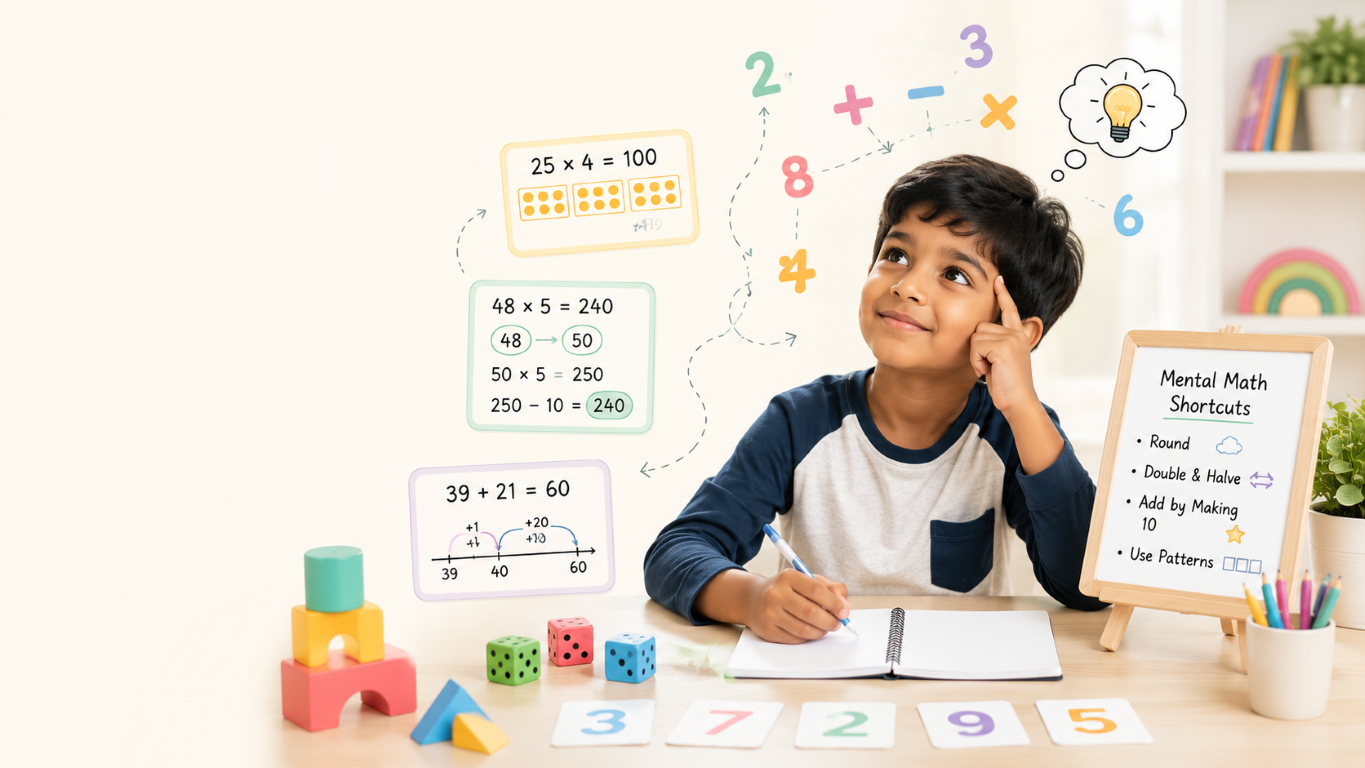
Mental math tricks help children calculate faster by teaching them to recognize number patterns, break numbers apart, round and adjust, double and halve, and use simple multiplication shortcuts. The goal isn't just speed—it is to build number sense, accuracy, flexibility, and confidence.
Mental math is an important part of children's mathematical development. Instead of depending on paper, fingers, or calculators for every calculation, children can learn to work with numbers mentally using strategies that make calculations simpler.
The key is to understand the strategy rather than simply memorize a trick. The reference material also emphasizes that effective mental math strategies reveal mathematical patterns, work across different problems, and can be explained by the child.
Whether your child is learning addition, subtraction, multiplication, or basic number operations, these mental math tricks for kids can make everyday practice more engaging.
Key Takeaways
- Mental math is a learnable skill, not something only naturally gifted children can do.
- Children should understand why a strategy works instead of memorizing shortcuts.
- Rounding, compensation, doubling, halving, and number patterns are useful beginner strategies.
- Short, regular practice is more useful than occasional long practice sessions.
- Real-life situations such as shopping, counting, cooking, and estimating can make mental math meaningful.
- Mental math can strengthen number sense, calculation fluency, problem-solving, and confidence.
What Is Mental Math for Kids?
Mental math is the ability to solve mathematical calculations in your head without relying on written calculations or a calculator.
For example, instead of writing:
48 × 5
a child can think:
48 ÷ 2 = 24 → 24 × 10 = 240
The answer is 240.
Mental math isn't about making children calculate everything as quickly as possible. It teaches them to look at numbers differently and choose an efficient strategy.
Why Are Mental Math Skills Important for Children?
Strong mental math skills can make everyday calculations easier and help children become more comfortable with numbers.
When children develop calculation fluency, they don't have to spend as much mental effort on basic arithmetic. This can leave more attention available for understanding and solving the larger problem.
Mental math also helps children develop:
- Number sense
- Calculation fluency
- Problem-solving skills
- Pattern recognition
- Logical thinking
- Estimation skills
- Mathematical confidence
The important point is that mental math should be taught as flexible mathematical thinking, not simply as a collection of shortcuts.
10 Easy Mental Math Tricks for Kids
1. Round Numbers and Adjust
Rounding makes difficult numbers easier to work with mentally.
Example:
38 × 6
Round 38 to 40:
40 × 6 = 240
You added 2 extra groups of 6, so subtract 12:
240 − 12 = 228
Answer: 228
Try another:
297 + 148
Round 297 to 300:
300 + 148 = 448
Because you added 3 extra:
448 − 3 = 445
This strategy can be used for addition, subtraction, multiplication, and estimation.
Parent tip: Ask your child, “Can we make one of these numbers easier first?”
2. Double and Halve
When one number is even, you can sometimes make multiplication easier by halving one number and doubling the other.
Example:
16 × 25
Half 16:
16 → 8
Double 25:
25 → 50
Now:
8 × 50 = 400
So:
16 × 25 = 400
This works because doubling one factor while halving the other keeps the product unchanged.
Try:
8 × 25
Half 8 → 4
Double 25 → 50
4 × 50 = 200
3. Multiply by 5 Using Half and ×10
Multiplying by 5 can be made easier by halving the number and multiplying by 10.
Example:
48 × 5
Half of 48:
48 ÷ 2 = 24
Multiply by 10:
24 × 10 = 240
So:
48 × 5 = 240
This is a particularly useful trick for children because it connects multiplication with familiar operations such as halving and multiplying by 10.
4. Multiply by 11
Multiplying two-digit numbers by 11 can reveal an interesting number pattern.
For example:
24 × 11
Add the digits:
2 + 4 = 6
Place 6 between 2 and 4:
264
So:
24 × 11 = 264
Another example:
53 × 11
5 + 3 = 8
53 × 11 = 583
For numbers where the digit sum is 10 or more, children need to use carrying.
For example:
75 × 11
7 + 5 = 12
The result is:
825
This type of activity can help children notice patterns within multiplication rather than treating every calculation as a separate problem.
5. Use the 9s Finger Trick
The 9 times table has a useful finger pattern.
Ask your child to hold up all ten fingers.
For:
9 × 7
Fold down the seventh finger.
There are:
6 fingers on the left → 6 tens
3 fingers on the right → 3 ones
So:
9 × 7 = 63
Children can also learn that many multiples of 9 have digits that add up to 9:
18 → 1 + 8 = 9
27 → 2 + 7 = 9
36 → 3 + 6 = 9
This can become a simple way for children to check their multiplication answers.
6. Use Compensation for Addition
Compensation means changing a number to make the calculation easier and then correcting the difference.
Example:
68 + 57
Turn 68 into 70:
70 + 57 = 127
Because you added 2 extra:
127 − 2 = 125
Answer:
68 + 57 = 125
Another example:
297 + 148
Think:
300 + 148 = 448
Then remove the extra 3:
448 − 3 = 445
This teaches children that numbers can be rearranged and adjusted instead of always being calculated in one fixed way.
7. Subtract From 100 or 1,000 Using Complements
Subtracting from round numbers can be made easier by thinking about the complement.
Example:
1000 − 357
Think:
9 − 3 = 6
9 − 5 = 4
10 − 7 = 3
Therefore:
1000 − 357 = 643
This strategy can help children become more comfortable with subtraction from 100, 1,000, 10,000, and other round numbers.
8. Break Numbers Into Smaller Parts
Large numbers can feel difficult when children try to calculate them all at once.
Breaking them into manageable parts makes mental calculations easier.
Example:
183 × 2
Break 183 into:
180 + 3
Double each:
180 × 2 = 360
3 × 2 = 6
Add:
360 + 6 = 366
So:
183 × 2 = 366
This strategy is useful for multiplication, addition, subtraction, and other calculations.
9. Use Number Bonds
Number bonds help children recognize combinations that make a particular number.
For example, number bonds to 10 include:
1 + 9 = 10
2 + 8 = 10
3 + 7 = 10
4 + 6 = 10
5 + 5 = 10
Once children know these combinations automatically, they can use them to solve larger calculations.
Example:
8 + 7
Think:
8 needs 2 to make 10.
Take 2 from 7:
8 + 2 = 10
7 − 2 = 5
So:
10 + 5 = 15
Number bonds are an excellent starting point for younger children developing basic mental arithmetic.
10. Estimate Before Calculating
Before solving a calculation exactly, encourage your child to estimate the answer first.
Example:
398 + 204
Round:
400 + 200 = 600
So the exact answer should be close to 600.
Now calculate:
398 + 204 = 602
The estimate helps the child recognize whether the final answer makes sense.
Estimation is particularly useful for real-world situations such as shopping, measuring, comparing quantities, and checking calculations.

Mental Math Tricks by Age
Not every mental math trick should be introduced at the same age. Start with strategies that match your child's current number knowledge.
| Age | Good Starting Skills |
|---|---|
| 4–5 years | Counting, comparing numbers, simple number bonds, adding small quantities |
| 5–6 years | Number bonds, doubles, counting on, simple addition and subtraction |
| 6–7 years | Doubles, halves, number bonds, estimation, simple multiplication patterns |
| 7–8 years | Rounding, compensation, ×5 and ×10 strategies, basic multiplication shortcuts |
| 8–10 years | ×11 patterns, more advanced multiplication strategies, mental estimation |
| 10+ years | More complex multiplication, division strategies, advanced mental calculation |
These are general starting points, not strict developmental rules. A child can move faster or need more time depending on their existing number sense and mathematical experience.
The reference material similarly recommends beginning with foundational fluency such as number bonds and doubles before introducing more advanced shortcuts.
How Can Parents Teach Mental Math at Home?
You don't need a complicated lesson plan.
Try a 5–10 minute mental math routine.
Step 1: Start Easy
Begin with calculations your child can solve successfully.
Step 2: Introduce One Strategy
For example, spend several days practicing rounding and adjusting.
Step 3: Think Aloud
Show your child how you think:
“I'm going to make 48 easier by thinking about 50.”
Step 4: Let Your Child Explain
Ask:
“How did you get that answer?”
This is more valuable than simply asking whether the answer is correct.
Step 5: Use Everyday Situations
Try questions while:
- Shopping
- Cooking
- Playing board games
- Counting toys
- Planning time
- Comparing prices
- Keeping scores
- Sharing snacks
Short, frequent practice is easier to maintain than long sessions. The reference material recommends keeping practice brief and regular and using real-world contexts rather than relying only on worksheets.
10 Fun Mental Math Activities for Kids
Mental math practice doesn't have to feel like homework.
1. Grocery Store Challenge
Ask:
“If this costs ₹40 and this costs ₹25, approximately how much will we spend?”
2. Mental Math Race
Give two children the same five questions and let them solve them mentally.
3. Number of the Day
Choose a number such as 24 and ask:
- What is 24 + 10?
- What is 24 − 4?
- What is double 24?
- What is half of 24?
- What numbers make 24?
4. Dice Math
Roll two dice and ask your child to add, subtract, or multiply the numbers.
5. Mental Math Bingo
Create a bingo card with answers. Call out calculations and let children find the matching answer.
6. What's the Missing Number?
25 + ? = 40
7. Estimate It
Ask your child to estimate how many objects are in a box before counting them.
8. Score Keeper
Use scores from a board game or sports game to practice addition.
9. Quick-Fire Questions
Ask five simple questions during a car ride or walk.
10. Parent vs Child
Take turns asking each other mental math questions.
Common Mistakes Parents Make When Teaching Mental Math
❌ Focusing Only on Speed
Mental math isn't a race.
A child who understands why an answer works is developing a more useful skill than a child who simply answers quickly.
❌ Teaching Too Many Tricks at Once
Introduce one technique at a time and give your child enough opportunities to use it.
❌ Asking Children to Memorize Everything
Shortcuts should support mathematical understanding, not replace it.
❌ Correcting Every Mistake Immediately
Instead ask:
“Can you check your answer another way?”
This encourages mathematical reasoning.
❌ Comparing Children
Every child develops mathematical fluency at a different pace. Focus on progress rather than comparison.
Mental Math Tricks vs. Memorization: What's Better?
Understanding mental math strategies is more valuable than memorizing isolated tricks.
For example, a child who memorizes that 48 × 5 = 240 has learned one answer.
A child who understands:
48 × 5 = 48 ÷ 2 × 10
has learned a strategy that can be applied to many numbers.
The strongest mental math techniques reveal patterns and can be generalized to different problems.
How Long Should Kids Practice Mental Math?
For most children, 5–10 minutes of focused practice can be a practical starting point.
The goal is consistency rather than exhausting practice sessions.
A simple routine could look like:
2 minutes: Number bonds
3 minutes: One mental math strategy
3 minutes: Fun challenge
2 minutes: Real-life math question
As children become comfortable, you can gradually increase the complexity rather than simply increasing the amount of practice.
How Do Mental Math Tricks Improve Number Sense?
Number sense is a child's intuitive understanding of numbers, quantities, relationships, and operations.
Mental math supports number sense because children repeatedly explore relationships between numbers.
For example, when a child learns that:
25 × 4 = 100
they begin to recognize useful relationships involving 25, 4, 50, 100, and multiplication.
Similarly, when they use compensation:
39 + 21 → 40 + 20 = 60
they learn that numbers can be restructured without changing the final result.
That flexibility is an important part of mathematical thinking.
A Simple 7-Day Mental Math Challenge for Kids
Want to start today? Try this:
| Day | Practice |
|---|---|
| Day 1 | Number bonds to 10 |
| Day 2 | Doubles and halves |
| Day 3 | Addition using compensation |
| Day 4 | Rounding and adjusting |
| Day 5 | Multiply by 5 and 10 |
| Day 6 | Mental multiplication patterns |
| Day 7 | Mixed mental math challenge |
Keep each session short, positive, and pressure-free.
Frequently Asked Questions
What are the easiest mental math tricks for kids?
Start with number bonds, doubles, halves, rounding, compensation, and multiplying by 5 or 10. These strategies are accessible and useful across many calculations.
What age should children start learning mental math?
Children can begin developing mental math skills as soon as they understand basic quantities and counting. Younger children can start with counting, number bonds, and simple addition.
How can I improve my child's mental math skills?
Practice for a few minutes each day using number games, mental addition, subtraction, multiplication patterns, estimation, and real-life math situations.
Are mental math tricks good for children?
Yes. When taught with understanding, mental math strategies can help children develop calculation fluency, number sense, flexible thinking, and confidence with numbers.
Should children memorize mental math tricks?
Children should understand the mathematical idea behind a strategy before trying to memorize it. Understanding makes the strategy easier to transfer to new problems.
How can I make mental math fun for kids?
Use games, dice, puzzles, shopping challenges, number cards, cooking measurements, board games, and quick mental-math questions instead of making every practice session worksheet-based.
What is the best mental math trick for beginners?
Number bonds and doubles are excellent starting points. Once children are comfortable, introduce rounding, compensation, and multiplication shortcuts.
Can mental math help children in school?
Yes. Mental calculation fluency can reduce the effort required for basic arithmetic and allow children to focus more on understanding mathematical problems and reasoning.
Final Thoughts
Mental math isn't about making children calculate like a calculator. It's about helping them understand numbers well enough to work with them flexibly.
Start with one strategy, practice it regularly, and encourage your child to explain their thinking. Over time, techniques such as rounding, compensation, doubling, halving, number bonds, and multiplication patterns can become natural tools for solving problems.
Most importantly, make mental math part of play and everyday life. A quick calculation while shopping, cooking, playing, or planning the day can become a valuable learning opportunity.
For ClassMonitor, this approach fits naturally with play-based mathematics, where children can build mathematical skills through activities, games, practice, and hands-on learning rather than relying only on traditional worksheets.