
Mental Math Tricks Every Child Should Learn | 20 Easy Math Hacks
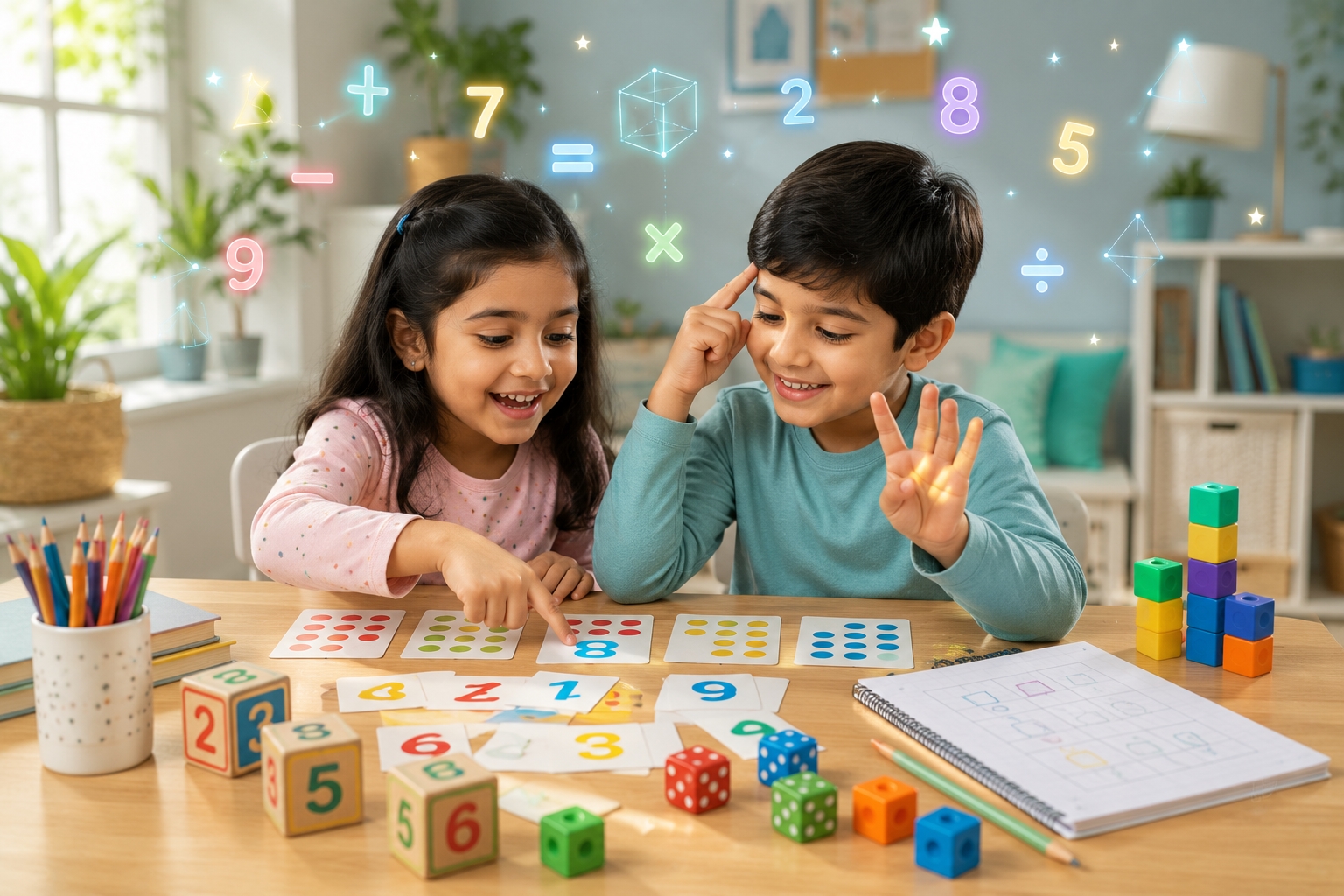
Mental math tricks help children solve calculations faster by using simple number patterns instead of lengthy calculations. When taught alongside basic math concepts, these tricks improve speed, accuracy, confidence, and problem-solving skills. The best mental math tricks include rounding numbers, multiplying by 9, doubling and halving, and breaking numbers into smaller parts.
Mental Math Tricks Every Child Should Learn: 20 Easy Shortcuts to Make Math Fun
Math doesn't always have to mean writing long calculations on paper.
Many everyday calculations—adding grocery bills, calculating discounts, estimating time, or splitting a pizza—can be done in seconds using simple mental math tricks.
These tricks aren't about avoiding learning. They're about helping children think smarter, recognize patterns, and become confident problem solvers.
The best part?
Children enjoy math much more when they discover fun shortcuts that actually make calculations easier.
In this guide, you'll learn 20 easy mental math tricks, understand why they work, discover the right age to teach them, and find practical ways to help your child practice every day.
What Are Mental Math Tricks?
Mental math tricks are simple calculation strategies that help children solve math problems quickly without using paper, calculators, or counting on fingers.
Instead of memorizing long steps, children learn to recognize number patterns and use logical shortcuts.
For example:
Instead of calculating:
38 × 5
A child can think:
38 × 10 = 380
380 ÷ 2 = 190
The answer appears much faster.
Mental math isn't about memorizing tricks—it helps children understand how numbers work together.
Why Should Children Learn Mental Math Tricks?
Mental math develops much more than fast calculation.
Children who regularly practice mental math often develop:
- Better number sense
- Faster calculations
- Improved concentration
- Stronger logical thinking
- Better memory
- Higher confidence in mathematics
- Reduced math anxiety
- Better performance in school exams
Most importantly, mental math encourages flexible thinking instead of relying on one fixed method.

When Should Kids Learn Mental Math Tricks?
The right age depends on your child's understanding of basic math concepts.
| Age | What to Teach |
| 4–5 years | Counting patterns, doubles, number bonds |
| 5–6 years | Simple addition and subtraction tricks |
| 6–8 years | Multiplication shortcuts, estimation |
| 8+ years | Advanced multiplication, squares, percentages |
Children should first understand why an operation works before learning shortcuts.
20 Mental Math Tricks Every Child Should Learn
Addition Tricks
1. Round and Adjust
Instead of:
47 + 39
Round to:
50 + 40 = 90
You added 3 and 1.
Subtract 4.
Answer = 86
Best for: Ages 7+
2. Break Numbers Apart
68 + 25
60 + 20 = 80
8 + 5 = 13
80 + 13 = 93
Children understand place value while calculating faster.
3. Add Left to Right
Instead of starting from the ones place,
Think:
42 + 35
40 + 30 = 70
2 + 5 = 7
Answer = 77
This improves estimation skills.
Subtraction Tricks
4. Count Up Instead of Subtracting
52 − 48
48 → 50 (+2)
50 → 52 (+2)
Answer = 4
This is much easier for young learners.
5. Round the Smaller Number
84 − 29
84 − 30 = 54
Add 1 back
Answer = 55
Multiplication Tricks
6. Multiply by 10
Simply add a zero.
35 × 10 = 350
One of the easiest tricks children can master.
7. Multiply by 5
Multiply by 10.
Divide by 2.
46 × 5
460 ÷ 2
= 230
8. Multiply by 9
Multiply by 10.
Subtract the original number.
26 × 9
260 − 26
= 234
9. Multiply by 11
34 × 11
3 (3+4) 4
= 374
If the middle number is greater than 9, carry the extra digit.
10. Double and Half
16 × 25
8 × 50
4 × 100
= 400
Great for even numbers.
11. Multiply by 25
Multiply by 100.
Divide by 4.
18 × 25
1800 ÷ 4
= 450
12. Square Numbers Ending in 5
35²
3 × 4 = 12
Attach 25
1225
One of the most enjoyable tricks for children.
13. Numbers Close to 100
98 × 97
Subtract differences:
2 and 3
98 − 3 = 95
2 × 3 = 06
Answer = 9506
Division Tricks
14. Divide by 5
Multiply by 2.
Move the decimal one place left.
145 ÷ 5
290
29
15. Divide by 25
Multiply by 4.
Move decimal two places.
200 ÷ 25
800
8
16. Learn Divisibility Rules
A number is:
- Divisible by 2 if it's even
- Divisible by 3 if digits add to a multiple of 3
- Divisible by 5 if it ends in 0 or 5
- Divisible by 10 if it ends in 0
These rules save time during calculations.
Everyday Mental Math Tricks
17. Estimate Before Solving
198 + 403
Think:
200 + 400
≈ 600
Now solve exactly.
18. Count by Groups
Instead of counting one by one,
Count:
2, 4, 6, 8
or
5, 10, 15, 20
This strengthens multiplication skills naturally.
19. Use Friendly Numbers
Instead of
49 + 27
Think
50 + 26
Answer = 76
20. Practice Number Bonds
Know pairs that make:
10
20
50
100
Example:
38 needs 12 to make 50.
This improves calculation speed dramatically.
Everyday Activities to Practice Mental Math
Parents don't need worksheets every day.
Try these simple activities:
- Add grocery prices while shopping.
- Count stairs in twos or fives.
- Estimate the restaurant bill.
- Skip count while walking.
- Play number guessing games.
- Roll dice and add mentally.
- Calculate cricket scores.
- Count coins.
- Use flashcards.
- Solve one mental math challenge at dinner.
Just 10–15 minutes daily can make a noticeable difference.
Common Mistakes Parents Should Avoid
Many parents unintentionally make mental math stressful.
Avoid these common mistakes:
- Teaching shortcuts before basic concepts
- Expecting speed over understanding
- Comparing siblings or classmates
- Practicing for long periods without breaks
- Correcting every mistake immediately
- Skipping real-life applications
- Relying only on worksheets
The goal is to build confidence, not just quick answers.
How ClassMonitor Makes Mental Math Fun
At ClassMonitor, we believe children learn math best through play, exploration, and hands-on experiences.
Our age-appropriate learning kits, engaging activities, puzzles, and interactive challenges help children develop strong number sense before introducing mental math shortcuts. By combining games, visual learning, and practical exercises, we make math enjoyable while building confidence, logical thinking, and problem-solving skills that last beyond the classroom.

Frequently Asked Questions
What are mental math tricks?
Mental math tricks are simple calculation techniques that help children solve math problems quickly using number patterns instead of lengthy written methods.
At what age should children learn mental math tricks?
Most children are ready to learn basic mental math tricks between 5 and 7 years, after they understand counting, place value, and simple addition and subtraction.
Do mental math tricks improve math skills?
Yes. Regular practice improves number sense, calculation speed, logical thinking, confidence, and overall mathematical fluency when combined with a strong understanding of math concepts.
Are mental math tricks useful in school exams?
Yes. Mental math tricks help children solve calculations faster, save time during exams, and reduce simple arithmetic errors. However, students should still understand the standard methods required for showing their work.
How can parents teach mental math at home?
Parents can practice mental math through everyday activities like shopping, cooking, counting objects, estimating totals, playing number games, and using flashcards. Short daily practice sessions are more effective than long study periods.
What's the difference between mental math and Vedic Math?
Mental math is a broad collection of calculation strategies that improve speed and number sense. Vedic Math is a specific system of techniques based on traditional mathematical principles. Many Vedic methods can be used as mental math strategies, but mental math also includes many other approaches.
Conclusion
Mental math tricks are more than clever shortcuts—they help children develop confidence, flexible thinking, and a deeper understanding of numbers. By learning age-appropriate strategies and practicing them in everyday situations, children can become faster, more accurate, and more comfortable with math.
Start with just a few simple tricks, encourage regular practice through fun activities, and gradually introduce more advanced techniques as your child's skills grow. With the right support and engaging learning experiences, mental math can become an enjoyable part of your child's daily life rather than a challenging subject.