
How Vocabulary Builds Better Readers: Why Word Knowledge Matters for Children
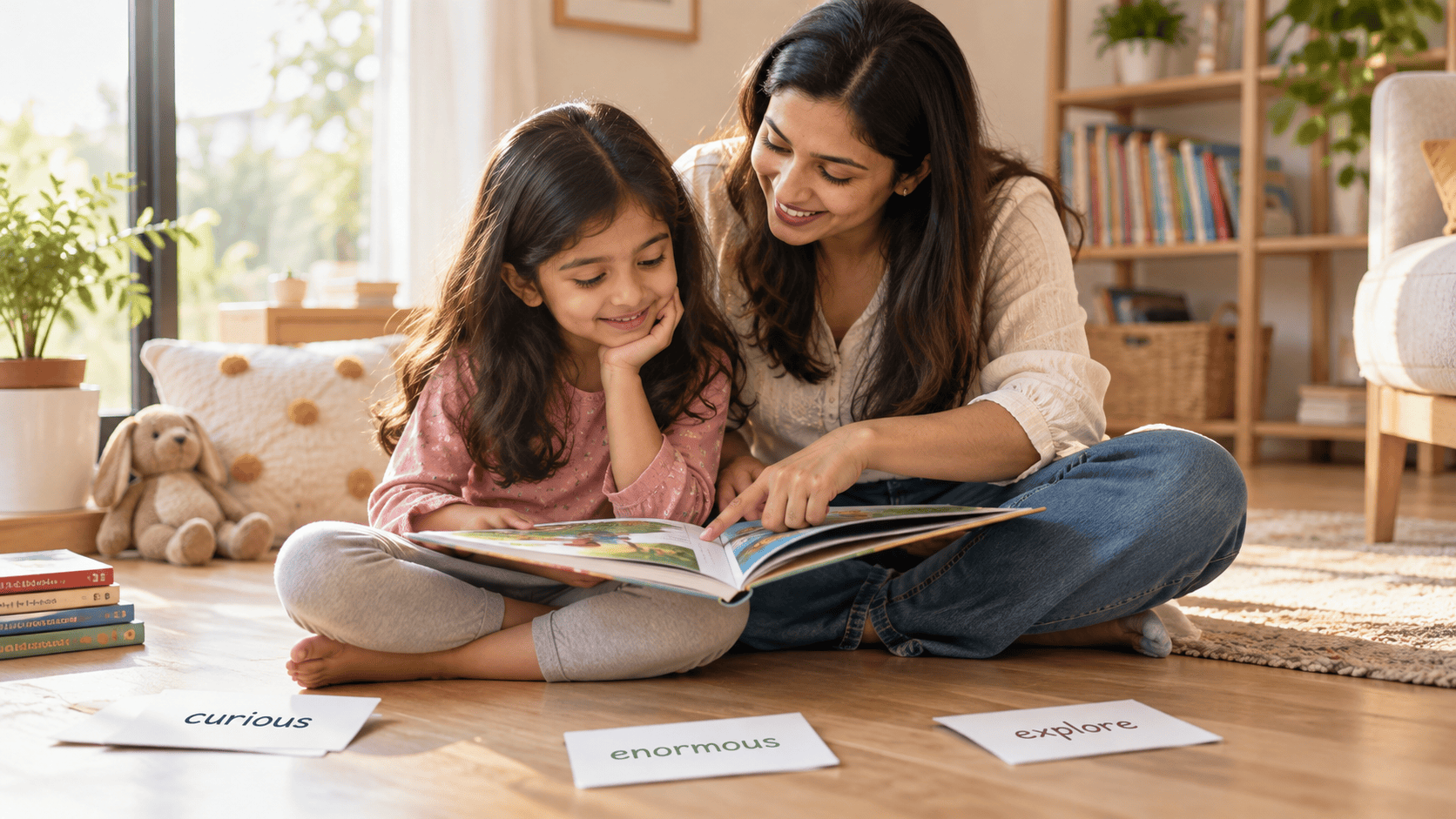
A child may be able to sound out a word correctly and still not understand what they are reading.
For example, imagine a child reading the sentence, “The rabbit hurried into the burrow.” They may successfully decode every word, but if words such as hurried or burrow are unfamiliar, the meaning of the sentence may still be unclear.
This is why learning to read is about more than recognising letters and sounding out words. Children also need to understand the words they encounter.
Vocabulary—the words children know, understand, hear, read, and use—is an important part of reading comprehension. Research from the National Reading Panel notes that a larger vocabulary can make it easier for readers to make sense of text.
For parents, this raises an important question: How does vocabulary build better readers, and how can we help children develop it naturally?
The answer begins long before a child reads their first book.
Why Is Vocabulary Important for Reading?
Vocabulary development begins in everyday conversations, stories, songs, play, and experiences. Before children become independent readers, they are already developing an oral vocabulary—the words they understand and use when listening and speaking.
When children later encounter those familiar words in print, their existing knowledge can support understanding.
The National Institute of Child Health and Human Development explains that children who already know a word from spoken language are better positioned to understand it when they encounter it while learning to read.
Vocabulary is therefore closely connected to reading comprehension, language development, and overall literacy.
But vocabulary does not replace phonics. Phonics helps children connect letters with sounds and decode unfamiliar words, while vocabulary helps them understand what those words mean. Strong reading development needs both skills working together.
How Does Vocabulary Build Better Readers?
1. Vocabulary Improves Reading Comprehension
Reading is ultimately about understanding meaning.
A child may correctly pronounce a sentence, but if several words are unfamiliar, they may struggle to understand the message.
Consider:
“The enormous elephant cautiously approached the watering hole.”
A child who understands enormous, cautiously, approached, and watering hole can create a much clearer mental picture of what is happening.
This is why vocabulary knowledge is closely associated with reading comprehension. Readers with broader word knowledge have more meaning available to them when they encounter text.

2. Vocabulary Helps Children Understand New Words in Context
Children do not learn every word through direct teaching.
They also encounter new vocabulary while listening to stories, talking with adults, watching educational content, exploring the world, and eventually reading independently.
For example, a child may not know the word enormous, but if a story says, “The enormous whale was bigger than the boat,” the surrounding information provides clues about its meaning.
Research on vocabulary and reading comprehension describes this relationship as reciprocal: vocabulary supports comprehension, while successful reading and comprehension can also expose children to more opportunities to learn new words.

3. Vocabulary Makes Reading More Meaningful
Children are more likely to engage with a story when they can understand what is happening.
Imagine reading a story about a jungle adventure. Words such as explore, tropical, camouflage, predator, and shelter can make the story more vivid.
The child is not simply reading words on a page. They are building connections between words, ideas, characters, events, and experiences.
A growing vocabulary gives children more tools for creating these mental connections.
4. Vocabulary Supports Independent Reading
As children become stronger readers, they encounter increasingly complex books.
They cannot rely on an adult to explain every unfamiliar word.
A strong vocabulary gives them a foundation for understanding more challenging texts. Children can also learn strategies for figuring out unfamiliar words using context, word parts, illustrations, dictionaries, and surrounding sentences.
This gradually supports independent reading.

5. Vocabulary Can Strengthen Speaking and Writing Too
Vocabulary development is not limited to reading.
Children who know more words have more options for expressing their thoughts.
Instead of saying:
“The dog went fast.”
a child might eventually say:
“The dog sprinted across the garden.”
That difference shows how vocabulary can make communication more precise and expressive.
Reading and vocabulary development can therefore support speaking and writing alongside comprehension.
What Are the Best Ways to Build Vocabulary for Better Reading?
There is no need to turn vocabulary learning into a long daily lesson. Children can build word knowledge through short, meaningful interactions.
Read Aloud Every Day
Reading aloud exposes children to words and sentence structures they may not hear frequently in everyday conversation.
Pause occasionally when you encounter an interesting word.
Ask:
“Do you know what this word means?”
Then explain it using simple language and connect it to something familiar.
For younger children, picture books are especially useful because illustrations provide additional context.
Talk About New Words
Instead of simply giving children dictionary definitions, use new words naturally throughout the day.
If your child learns the word enormous, you might say:
“Look at that enormous truck!”
Later, ask:
“Was the little car enormous or small?”
Repeated exposure helps children develop a stronger understanding of words. Research-supported vocabulary practices emphasise meaningful contexts and multiple exposures rather than introducing a word only once.
Play Word Games
Vocabulary practice does not have to feel like studying.
Try:
Opposite Game:
Hot → Cold
Big → Small
Fast → Slow
Synonym Game:
Happy → Cheerful
Big → Huge
Quick → Fast
Guess the Word:
“I am thinking of something that is very big. What word could describe it?”
Word Detective:
Ask your child to find a new or interesting word while reading a story.
Games encourage children to notice how words work while keeping learning interactive.
Encourage Storytelling
Give your child three words and ask them to create a story.
For example:
Forest – Treasure – Curious
The child could create a short story using all three words.
This activity combines vocabulary, imagination, speaking, sequencing, and comprehension.

Connect Words to Real Experiences
Children understand vocabulary more deeply when they can connect words to something they have experienced.
If your child learns fragile, show them something that needs to be handled carefully.
If they learn transparent, show them a glass window.
If they learn enormous, compare two objects of different sizes.
Meaning becomes easier to remember when children can see, touch, experience, or use the concept.
How Does Vocabulary Benefit Children Beyond Reading?
Vocabulary development can support several areas of children's learning.
A richer vocabulary can help children understand classroom instructions, participate in conversations, explain their ideas, and engage with different subjects.
Vocabulary also becomes increasingly important as children encounter more specialised academic language.
A child reading a science lesson, for example, may encounter words such as habitat, adaptation, evaporation, or organism.
Understanding subject-specific vocabulary can make the content itself easier to access.
Recent research also highlights that vocabulary and reading comprehension are closely connected throughout development, while suggesting that vocabulary instruction should work alongside subject knowledge and comprehension strategies rather than being treated as the only component of reading instruction.
Vocabulary and Phonics: What's the Difference?
Parents sometimes wonder whether they should focus on vocabulary or phonics.
The answer is that both have different jobs.
Phonics helps children understand the relationship between letters and sounds. It gives them tools for decoding unfamiliar words.
Vocabulary helps children understand what those words mean.
For example, a child may use phonics to decode ship. But knowing that a ship is a large boat used to travel on water gives the child meaning.
This is why effective early reading development combines foundational decoding skills with language comprehension and vocabulary development.
ClassMonitor's existing phonics resources similarly focus on connecting sounds and letters, blending, word reading, and building foundational reading skills.
Expert Tips for Parents: Build Vocabulary Without Pressure
Make reading a conversation. Don't just ask, “What happened?” Ask, “Why do you think the character did that?”
Introduce fewer words, but revisit them. Children benefit from hearing and using words repeatedly in different contexts.
Don't interrupt every sentence. Choose useful or interesting words rather than stopping constantly.
Use simple explanations. A child-friendly explanation is often more useful than a complicated dictionary definition.
Encourage questions. When children ask, “What does that mean?”, treat it as an opportunity to build language.
Let children see words in action. Use new vocabulary during conversations, games, storytelling, and everyday activities.
Keep reading enjoyable. The goal is not to turn every story into a vocabulary test. The goal is to help children become curious about words.
A Simple 10-Minute Vocabulary Routine for Kids
You don't need an hour-long lesson to build vocabulary.
Try this simple routine:
Minutes 1–3: Read
Read a short story or a few pages together.
Minutes 4–5: Discover
Choose one or two interesting words.
Minutes 6–7: Explain
Talk about what the words mean and give an everyday example.
Minutes 8–9: Use
Ask your child to make a sentence using one of the words.
Minute 10: Play
Turn the word into a quick guessing, drawing, acting, or synonym game.
The important part is consistency. Small, enjoyable interactions can create repeated opportunities for children to hear, understand, and use new words.

How ClassMonitor Supports Early Reading and Language Development
At ClassMonitor, we believe children learn best when learning feels engaging, age-appropriate, and connected to real skills.
Vocabulary development can be naturally combined with phonics, reading practice, spelling, storytelling, communication, and interactive learning activities.
ClassMonitor's learning resources and programs are designed to help children develop foundational academic and communication skills through structured and engaging learning experiences.
Parents can explore ClassMonitor's Phonics for Kids resources to understand how phonics, decoding, pronunciation, and vocabulary can work together as children develop their early reading skills.
You can also explore ClassMonitor's existing guide on vocabulary activities for kids for additional ideas to practise words through games, stories, conversations, and everyday activities.
Recommended ClassMonitor Blogs
If you're looking to build your child's reading and language skills further, these ClassMonitor resources are useful next reads:
Phonics for Kids: Complete Parent Guide to Early Reading Skills — Understand the foundations of phonics and how children move from sounds to words.
Easy Way to Raise a Reader — Practical ideas for developing reading habits and encouraging children to enjoy books.
30 Vocabulary Activities for Kids — Fun vocabulary-building activities for different ages.
Phonics & Word Families: A Detailed Guide — Learn how word patterns can support reading, spelling, and vocabulary development.
Frequently Asked Questions
How does vocabulary help children become better readers?
Vocabulary helps children understand the meaning of the words they encounter while reading. When children know more words, they can focus more effectively on understanding sentences, stories, and information rather than struggling with unfamiliar meanings.
What is the connection between vocabulary and reading comprehension?
Vocabulary and reading comprehension are closely connected. Children need to understand the words in a text to understand its overall meaning. Research has found meaningful relationships between vocabulary knowledge and reading comprehension.
How can I improve my child's vocabulary at home?
Read aloud together, introduce new words during everyday conversations, play word games, encourage storytelling, discuss unfamiliar words in books, and give children opportunities to use new vocabulary in their own sentences.
Is vocabulary more important than phonics?
Vocabulary and phonics serve different purposes. Phonics helps children decode written words by connecting letters and sounds, while vocabulary helps them understand the meaning of those words. Both contribute to successful reading development.
At what age should children start learning vocabulary?
Vocabulary development starts from infancy through everyday interaction and continues throughout childhood. Parents can build vocabulary from the earliest years through talking, singing, reading aloud, storytelling, and play.
Does reading help children learn new vocabulary?
Yes. Reading exposes children to words and contexts they may not encounter in everyday conversation. Discussing unfamiliar words and encountering them repeatedly can make vocabulary learning more meaningful.
Better readers are not simply children who can pronounce more words. They are children who can understand, connect, question, imagine, and use the words they encounter.
Vocabulary gives children the language they need to make sense of stories, follow ideas, understand information, and express their own thoughts.
So the next time your child asks, “What does that word mean?”, don't see it as an interruption to reading.
See it as part of learning to read.
Because every new word a child understands can become another building block for stronger reading, richer communication, and lifelong learning.


