
How to Improve Mental Math Skills in Kids at Home: 15 Fun Activities
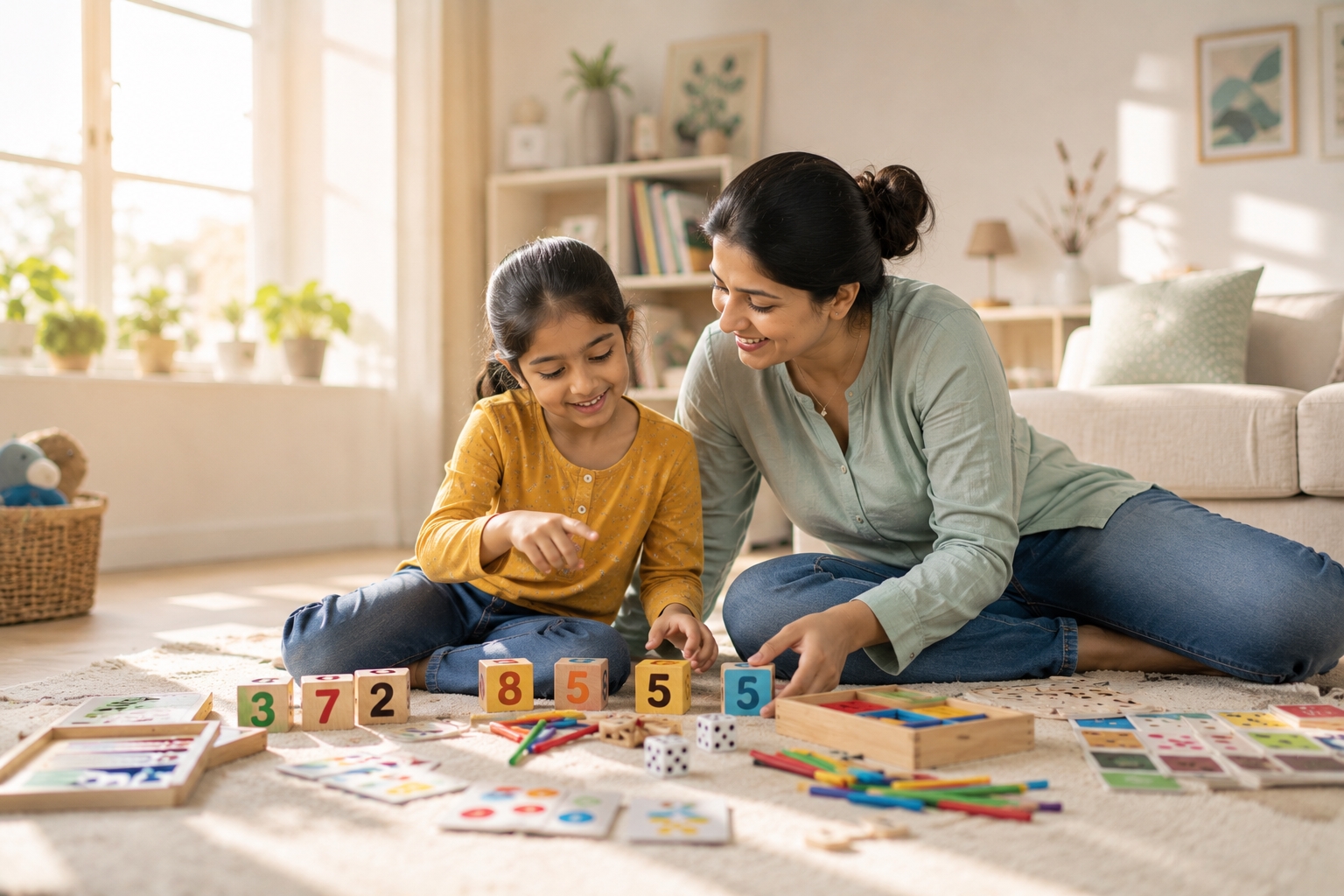
How to Improve Mental Math Skills in Kids at Home
Mental math skills help children solve calculations quickly without using paper or calculators. Parents can improve mental math at home through daily counting games, board games, shopping activities, cooking, skip counting, number puzzles, estimation games, and positive encouragement. Consistent practice builds confidence, number sense, and faster problem-solving.
"What's 25 + 17?"
Some children answer instantly.
Others start counting on their fingers.
The difference isn't intelligence.
It's number sense.
Mental math isn't about memorizing difficult calculations. It's about helping children understand numbers so well that solving problems becomes natural.
The good news?
Parents don't need expensive tuition or hours of worksheets.
Just 10–15 minutes of playful math every day can significantly improve a child's calculation speed, confidence, and logical thinking.
In this guide, you'll learn practical, age-appropriate ways to improve your child's mental math skills using everyday activities.
What Is Mental Math?
Mental math is the ability to solve math problems without writing them down or using calculators.
Instead of memorizing formulas, children learn to:
- recognize number patterns
- estimate answers
- calculate quickly
- think logically
- solve problems confidently
Example:
Instead of calculating
29 + 31
A child thinks
30 + 30 = 60
Simple.
Fast.
Smart.
Why Are Mental Math Skills Important?
Children with strong mental math skills often:
✔ Solve problems faster
✔ Build confidence
✔ Improve logical thinking
✔ Understand numbers deeply
✔ Perform better in school
✔ Reduce math anxiety
✔ Develop better concentration
✔ Prepare for Olympiads and competitive exams
Signs Your Child Needs Better Mental Math Practice
Your child may need support if they:
- Count on fingers for simple addition
- Depend heavily on calculators
- Struggle with multiplication tables
- Take a long time to solve basic sums
- Avoid math homework
- Lack confidence in mathematics

15 Best Ways to Improve Mental Math Skills at Home
1. Count Everything
Count:
stairs
toys
cars
books
spoons
Best for Ages 3–6
2. Practice Skip Counting
2s
5s
10s
25s
100s
Improves multiplication naturally.
3. Play Shopping Games
Ask:
"We have $20.
This costs $8.
How much money is left?"
4. Use Cooking to Teach Fractions
Half
Double
Quarter
Measure ingredients together.
5. Encourage Estimation
Before counting:
"How many candies do you think are in the bowl?"
Then count together.
6. Play Dice Games
Add numbers
Subtract
Multiply
Double
Excellent for quick thinking.
7. Make Mental Math Part of Car Rides
Ask:
"What is 15 plus 15?"
"If we have 8 apples and eat 3?"
Fun.
No pressure.
8. Practice Number Bonds
10
20
50
100
These improve calculation speed dramatically.
9. Teach Number Patterns
Odd
Even
Multiples
Counting by tens
Recognizing patterns builds mathematical thinking.
10. Solve Everyday Problems
"We need 4 plates.
Three people are coming.
How many plates?"
11. Use Flashcards as Games
Never as tests.
Keep it playful.
12. Play Board Games
Monopoly
Uno
Yahtzee
Ludo
Snakes & Ladders
All strengthen number skills.
13. Encourage Mental Multiplication
Teach tricks like:
25 × 4
Think:
100
instead of traditional multiplication.
14. Celebrate Thinking
Instead of saying
"Correct."
Ask
"How did you solve that?"
Reasoning matters.
15. Practice Every Day
Ten minutes daily beats one hour once a week.
Consistency wins.

Age-Wise Mental Math Activities
Ages 3–5
Count toys
Match numbers
Sorting games
Shape games
Counting songs
Ages 6–8
Addition games
Subtraction races
Dice games
Shopping math
Calendar math
Ages 9–12
Estimation
Fractions
Percentages
Budgeting
Mental multiplication
Logic puzzles
Mental Math Games Kids Love
- Card games
- Sudoku
- Dominoes
- Math Bingo
- Number Treasure Hunt
- Number Puzzles
- Make 24
- Guess My Number
- Monopoly
- Tangram
Common Mistakes Parents Make
❌ Focusing only on speed
❌ Comparing siblings
❌ Using worksheets every day
❌ Correcting every mistake
❌ Making math stressful
Instead:
✔ Celebrate effort
✔ Encourage reasoning
✔ Keep learning playful
Daily 10-Minute Mental Math Routine
Minute 1–2
Skip counting
Minute 3–4
Flashcards
Minute 5–6
Shopping math
Minute 7–8
Dice game
Minute 9–10
Mental challenge
How ClassMonitor Makes Mental Math Fun
At ClassMonitor, we believe children learn mathematics best when they can touch, play, explore, and discover.
Our play-based learning resources help children:
- Build strong number sense
- Improve mental calculation
- Develop logical thinking
- Strengthen problem-solving skills
- Learn through games, puzzles, flashcards, and hands-on activities
- Build confidence without the pressure of rote memorization
By turning everyday math into engaging experiences, ClassMonitor helps children enjoy learning while developing the mental math skills they need for school and beyond.
Frequently Asked Questions
How can I improve my child's mental math skills at home?
Practice daily using counting games, shopping activities, cooking, dice games, estimation exercises, and number puzzles. Short, fun sessions build stronger mental math skills than long worksheets.
What age should children start learning mental math?
Children can begin developing early mental math skills as young as 3–4 years old through counting, sorting, matching, and number recognition games. More advanced calculation strategies can be introduced gradually as they grow.
What are the best mental math activities for kids?
Some of the best activities include skip counting, number bond games, estimation challenges, dice games, card games, cooking measurements, shopping calculations, and puzzle-solving.
Why is mental math important for children?
Mental math improves calculation speed, number sense, logical thinking, confidence, concentration, and problem-solving abilities. It also helps children perform better in school and everyday situations.
Can mental math improve school performance?
Yes. Children with strong mental math skills often solve problems faster, understand mathematical concepts more deeply, and approach classroom learning with greater confidence.
How often should kids practice mental math?
About 10–15 minutes of daily practice is generally more effective than occasional long study sessions. Regular, playful practice helps build lasting confidence and fluency.
Conclusion
Mental math is more than quick calculations—it's the foundation of confident problem-solving, logical thinking, and lifelong mathematical success. By making math a natural part of everyday life through games, conversations, cooking, shopping, and playful challenges, parents can help children develop strong number sense without stress. With consistent encouragement and engaging activities, children become faster, more confident learners who enjoy exploring the world of numbers. ClassMonitor supports this journey through hands-on, play-based learning experiences that make building mental math skills both effective and enjoyable.