
How to Help Kids Overcome Stage Fear | Parent’s Guide
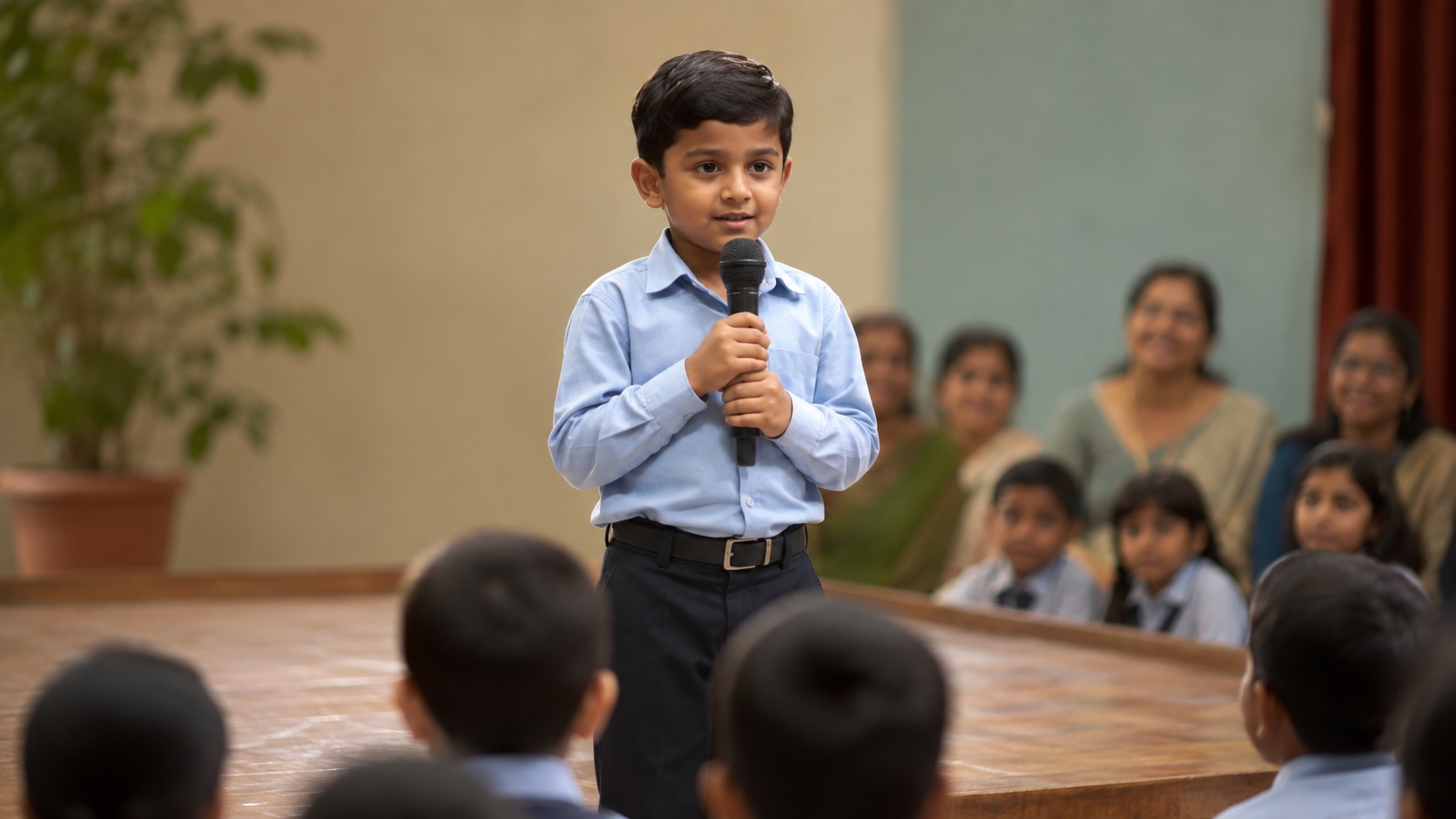
How to Help Kids Overcome Stage Fear
Does your child suddenly become quiet when asked to speak in front of the class? Do they forget their lines during a school function, avoid participating in competitions, or say, “I don't want to go on stage”?
You're not alone.
Stage fear is common among children, especially when they are expected to speak, perform, sing, act, recite, or answer questions in front of an audience. A child may experience a racing heart, sweaty hands, shaky voice, nervousness, or even a complete mental blank.
The good news is that stage confidence is a skill that can be developed. Children do not need to become naturally outgoing or fearless. With patient support, regular practice, and small opportunities to speak, they can gradually become more comfortable in front of others.
The key is not to force a child to “stop being scared.” Instead, parents can help children understand their feelings and take manageable steps toward the situations they find difficult. The American Academy of Pediatrics recommends supportive conversations, positive self-talk, relaxation techniques, and gradually facing fears rather than pressuring children to simply “be brave.”
How Can I Help My Child Overcome Stage Fear?
To help kids overcome stage fear, start with small speaking opportunities, practise regularly at home, use positive encouragement, teach simple breathing and self-talk techniques, and gradually increase the size of the audience. Avoid criticism, comparisons, or forcing a child onto the stage before they are ready.
What Is Stage Fear in Children?
Stage fear, also called stage fright or performance anxiety, is the nervousness or fear a child may experience before or during a performance or speaking activity.
It can happen during:
- School assemblies
- Class presentations
- Storytelling
- Poetry recitation
- Debates
- Dance or music performances
- School plays
- Speech competitions
- Show-and-tell
- Public speaking activities
- Family gatherings
A child experiencing stage fear may:
- Avoid eye contact
- Speak very softly
- Forget memorised lines
- Cry or refuse to participate
- Shake or fidget
- Complain of a stomachache
- Ask to go home
- Become unusually quiet
- Say “I can't do it”
- Avoid future performances
These reactions do not necessarily mean a child lacks confidence. Nervousness before speaking in front of a group can be a normal response to a new or challenging situation.
Why Do Kids Get Stage Fright?
There isn't one reason why children experience stage fear. Different children can have very different triggers.
1. Fear of Making Mistakes
A child may worry:
“What if I forget my lines?”
“What if everyone laughs?”
“What if I say the wrong answer?”
The fear of making mistakes can become stronger when children feel that their performance is being judged.
2. Fear of Being Watched
Standing in front of a group can feel very different from talking to parents or friends.
Suddenly, everyone seems to be looking at them.
3. Lack of Practice
A child who has never spoken in front of an audience may naturally feel uncomfortable the first few times.
Practice helps make the experience more familiar.
4. Pressure to Perform Perfectly
Statements such as:
- “You must win.”
- “Don't make any mistakes.”
- “Everyone is expecting you to do well.”
can unintentionally increase pressure.
Children benefit more when parents focus on effort, preparation and courage rather than perfection.
5. A Naturally Quiet Temperament
Being shy or introverted does not mean a child cannot become a good speaker.
The American Academy of Pediatrics notes that children differ in how comfortable they are around unfamiliar people and recommends small social steps and role-playing rather than expecting every child to behave like an extrovert.
10 Ways to Help Kids Overcome Stage Fear
1. Start Small
Don't begin with a large audience.
If your child is nervous about speaking in front of 50 people, start with one trusted person.
Try this progression:
Parent → Parents → Sibling → Grandparents → Small group → Classroom → Larger audience
Starting small gives children opportunities to experience success without overwhelming them.
PBS KIDS similarly recommends starting with manageable participation and gradually moving toward larger performance opportunities.
2. Practise at Home
Practice can make an unfamiliar situation feel predictable.
Turn your home into a mini stage.
Ask your child to:
- Introduce themselves
- Tell a short story
- Recite a poem
- Explain their favourite toy
- Describe a picture
- Give a one-minute talk
- Pretend to be a teacher
- Present something they learned
Keep the practice fun rather than turning every session into a test.
Try the “1-Minute Speaker” Game
Give your child a simple topic such as:
My favourite animal
My favourite food
My best friend
A place I want to visit
Let them speak for one minute.
Don't interrupt to correct every mistake.
The goal is to build comfort and fluency before perfection.
3. Use Role-Play
Role-playing can help children prepare for situations before they actually happen.
Pretend you are the audience.
For example:
Parent: “Good morning! Please introduce yourself.”
Child: “Good morning. My name is Aarav. Today I am going to talk about…”
Then switch roles.
Let your child become the teacher, while you become the student.
Role-play is particularly useful because children can rehearse both what to say and what to do when they feel nervous.
4. Teach Simple Breathing Techniques
Children may notice physical signs of nervousness before a performance—such as a racing heart, sweating or shaking.
Teach your child one simple breathing routine:
Breathe in slowly → pause → breathe out slowly.
Practise it when your child is calm, not only moments before a performance.
You can turn it into a game:
“Smell the Flower, Blow the Candle”
🌸 Smell the flower: Take a slow breath in.
🕯️ Blow the candle: Slowly breathe out.
Repeat a few times.
Simple relaxation and breathing techniques can help children learn to manage anxious feelings.

5. Replace “I Can't” With “I Can Try”
Children often use negative self-talk when they feel nervous.
Instead of:
“I can't speak in front of everyone.”
Help them practise:
“I can try.”
Instead of:
“I'll forget everything.”
Try:
“I know my first line.”
Instead of:
“Everyone will laugh.”
Try:
“It's okay to make a mistake.”
Positive self-talk is one of the strategies recommended by the American Academy of Pediatrics for helping children manage fears and worries.
6. Focus on the Message, Not Perfection
One of the biggest mistakes parents can make is focusing only on performance.
Instead of asking:
“Did you get everything right?”
ask:
- “What did you enjoy?”
- “What did you learn?”
- “What part felt easy?”
- “What part felt difficult?”
- “What would you like to practise next time?”
This shifts the child's attention from “I must perform perfectly” to “I am learning a skill.”
7. Praise Courage and Effort
Your child does not have to give a perfect performance to deserve praise.
If your child walks onto the stage despite feeling nervous, that itself is progress.
Try saying:
“I saw that you were nervous, but you still tried. That's brave.”
or
“You kept going even after you forgot one line. I'm proud of you.”
The goal is to reinforce brave behaviour and effort, not just winning or receiving applause.
8. Don't Compare Your Child With Other Kids
Avoid statements such as:
❌ “Look at how confidently your friend speaks.”
❌ “Why can't you speak like her?”
❌ “Your brother never gets scared.”
Comparison can make a child feel that something is wrong with them.
Instead, compare your child's progress with their own previous attempts.
Yesterday:
“I don't want to speak.”
Today:
“I'll practise with Mum.”
Next time:
“I'll speak in front of three people.”
That's progress.
9. Give Children More Opportunities to Speak
Confidence grows through repeated, low-pressure experiences.
You can create speaking opportunities during everyday life.
Ask your child to:
- Order their own food politely
- Introduce a family member
- Explain how they built a LEGO model
- Tell grandparents about school
- Read a short story aloud
- Explain the rules of a game
- Share something interesting they learned
- Give a mini presentation at home
These activities help children practise communication without making every speaking opportunity feel like a “performance.”
10. Make Speaking Fun
Children learn best when practice doesn't feel like punishment.
Try these stage-confidence games at home:
🎤 Pretend News Reporter
Your child reports the “news” from your living room.
🎭 Character Challenge
Ask your child to speak as a favourite story character.
🎲 Pick & Speak
Write simple topics on paper. Pick one and speak for 30 seconds.
🧸 Toy Audience
Place stuffed toys in front of your child and let them give a presentation.
📖 Story Retelling
Read a short story together and ask your child to retell it in their own words.
🎤 Family Talk Show
One person becomes the interviewer and another becomes the guest.
The purpose isn't perfect grammar or delivery. It's to make speaking feel normal, playful and safe.
What Parents Should NOT Do When a Child Has Stage Fear
Sometimes well-intentioned parenting can accidentally increase performance pressure.
Avoid:
❌ Forcing the child onto the stage
If a child is extremely distressed, forcing them into the situation can make the fear stronger.
❌ Making fun of their nervousness
Never ridicule a child's fear, particularly in front of others. The AAP specifically advises parents against belittling or ridiculing children's fears.
❌ Demanding perfection
A forgotten line doesn't mean the entire performance failed.
❌ Overcorrecting
Constantly interrupting a child while they speak can make them more worried about making mistakes.
❌ Comparing them with confident children
Every child develops confidence at a different pace.
❌ Avoiding every speaking opportunity
At the same time, completely removing every situation that makes a child nervous can prevent them from learning that they can cope with the feeling.
A better approach is gradual, supported exposure—small steps that become progressively more challenging. This principle is also used in evidence-based treatment approaches for childhood anxiety.

Stage Fear vs Shyness: What's the Difference?
| Stage Fear | Shyness |
| Usually appears around performance or speaking situations | Can appear in unfamiliar social situations |
| May include physical nervousness | May involve hesitation or withdrawal |
| Can happen even to normally confident children | Often linked to temperament |
| May improve with practice and gradual exposure | Can reduce as social comfort grows |
| Often connected to fear of making mistakes or being judged | Often connected to unfamiliar people or environments |
A child can be shy and experience stage fear, but the two are not exactly the same.
How Can I Prepare My Child Before a Stage Performance?
Use this simple 5-step pre-stage routine:
1. Prepare
Make sure your child knows what they need to say or do.
2. Practise
Rehearse aloud several times.
3. Relax
Take a few slow breaths.
4. Encourage
Say something simple such as:
“You don't have to be perfect. Just give it a try.”
5. Celebrate
Praise the effort after the performance, regardless of the outcome.
Preparation and practice are also recommended strategies for managing fear of public speaking.

A Simple 7-Day Stage Confidence Challenge
Parents can try this at home:
Day 1: Speak for 30 seconds to a parent.
Day 2: Retell a favourite story.
Day 3: Speak to both parents.
Day 4: Present a favourite toy.
Day 5: Speak to three family members.
Day 6: Record a one-minute video.
Day 7: Give a mini presentation to the family.
Keep each session short and positive.
If your child isn't ready for the next step, repeat the previous one. Progress doesn't have to happen on a fixed schedule.
How Does Public Speaking Help Children?
Helping children overcome stage fear isn't only about school performances.
Regular speaking practice can help children develop:
- Communication skills
- Vocabulary
- Listening skills
- Confidence
- Storytelling ability
- Organised thinking
- Self-expression
- Social interaction
- Presentation skills
Public speaking is a learnable skill rather than something children simply “have” or “don't have.”
For young children especially, activities such as storytelling, role-play, games and everyday conversations can provide natural opportunities to practise communication.
When Should Parents Seek Extra Help?
Occasional nervousness is usually not a reason for concern.
However, parents should pay attention when anxiety becomes persistent, intense or disruptive.
Consider speaking with your child's pediatrician or a qualified mental-health professional if your child:
- Consistently avoids school or activities because of fear
- Experiences severe distress around speaking situations
- Has frequent physical symptoms linked to anxiety
- Stops participating in activities they previously enjoyed
- Has anxiety that interferes with everyday life
- Continues to become increasingly fearful despite supportive practice
The AAP recommends seeking professional guidance when anxiety does not improve or begins interfering with a child's normal activities.
Frequently Asked Questions
1. How can I help my child overcome stage fear quickly?
There is no guaranteed overnight solution. The most helpful approach is usually gradual practice, positive encouragement, relaxation techniques and small speaking opportunities. Avoid forcing or shaming the child.
2. Why does my child forget everything on stage?
Nervousness can affect concentration and make a child feel as though their mind has gone blank. Practising aloud and becoming familiar with the performance environment can help.
3. Is stage fear normal in children?
Yes. Feeling nervous before speaking or performing can be normal. What matters is how intense the fear is and whether it interferes with your child's everyday activities.
4. How can I make my child confident in public speaking?
Give them frequent, low-pressure opportunities to talk. Start with familiar people, use storytelling and role-play, practise short talks, and gradually increase the audience.
5. Should I force my shy child to speak on stage?
It is generally better to use gradual steps rather than forcing a child into an overwhelming situation. Start with manageable challenges and build from there.
6. What activities help children overcome stage fear?
Storytelling, role-play, show-and-tell, pretend interviews, family presentations, picture description, toy presentations and one-minute speaking games are simple activities parents can use at home.
7. How can I calm my child before a performance?
Keep your conversation positive and brief. Practise slow breathing, remind them of their first line or key points, and reassure them that they don't need to be perfect.
8. Can stage fear be completely eliminated?
The goal doesn't have to be eliminating nervousness completely. A more useful goal is helping children feel nervous and still be able to participate. Even experienced performers can feel nervous before going on stage.
Final Thoughts
A child who is afraid of the stage today can become a confident speaker tomorrow—but confidence rarely appears all at once.
It grows through practice, encouragement, play and positive experiences.
So instead of saying:
“Don't be scared.”
try:
“I know you're nervous. Let's take one small step together.”
That small step could be telling a story to Mum, explaining a game to Dad, speaking to three family members, or eventually standing in front of a classroom.
Every time a child tries, they learn something important:
“I can do difficult things.”
And that is the foundation of real confidence.
How ClassMonitor Can Help
At ClassMonitor, we believe children learn important life skills through engaging, age-appropriate activities. Play-based learning, storytelling, communication games and structured activities can give children safe opportunities to express ideas, practise language and build confidence.
For parents looking to develop their child's communication, public speaking, confidence and overall learning skills, explore ClassMonitor's range of learning resources designed to make practice more interactive and enjoyable.