
English Vocabulary for Children: Complete Guide for Parents
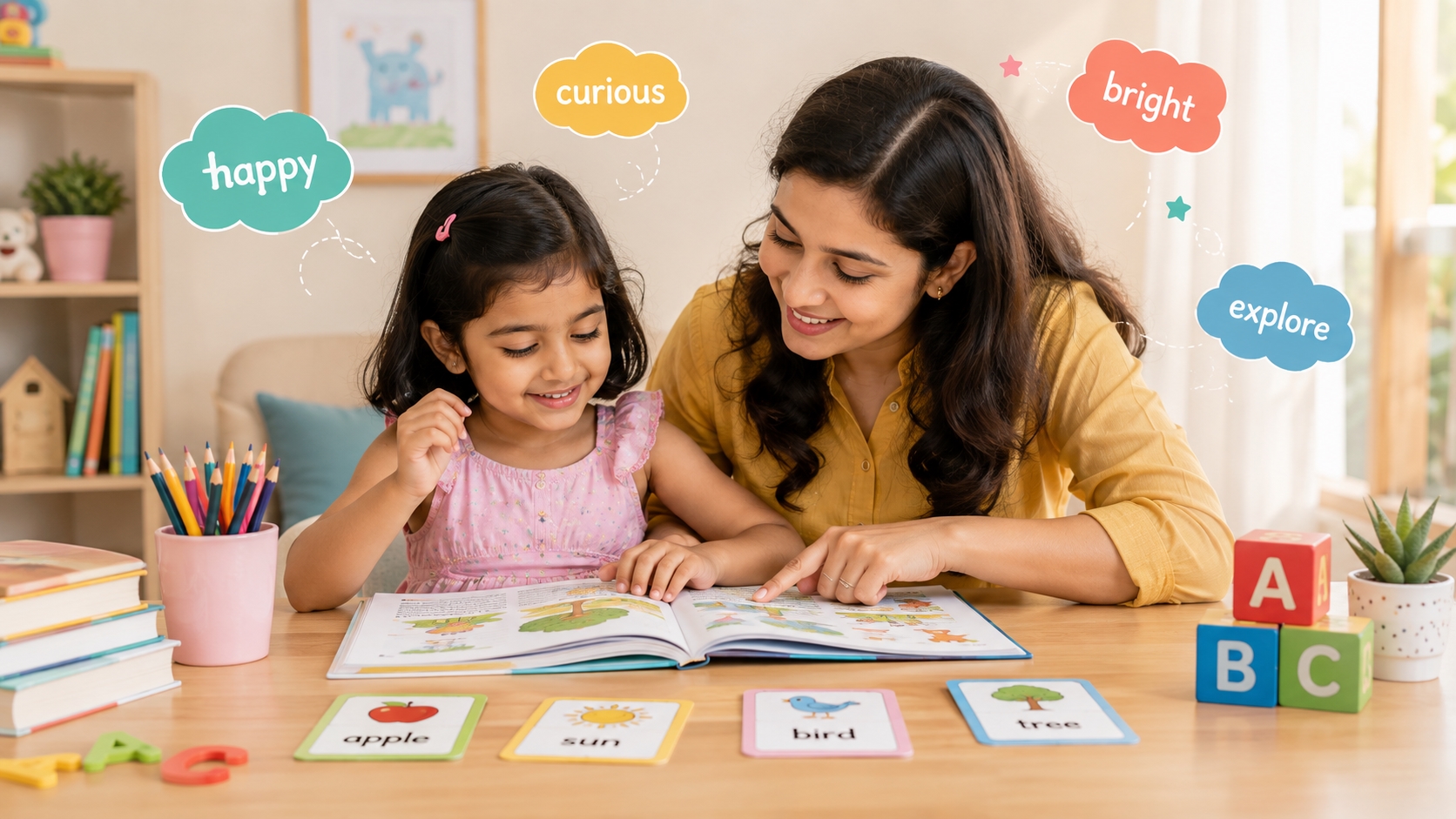
English Vocabulary for Children: Complete Guide for Parents
A strong vocabulary helps children understand what they hear, express what they think, communicate confidently, and become better readers. But building vocabulary does not have to mean memorizing long word lists.
For young children, the best vocabulary learning happens naturally through stories, conversations, play, songs, everyday experiences, and simple activities.
In this guide, parents will learn what English vocabulary is, why vocabulary development matters, how to build vocabulary at home, which words children can learn at different ages, and how sight words and phonics support early reading.
What Is English Vocabulary for Children?
English vocabulary for children is the collection of words a child understands and uses while listening, speaking, reading, and writing.
A child's vocabulary includes more than words they can say. It also includes words they understand when someone else uses them.
For example, a child may understand the word “enormous” when hearing a story but may not yet use it while speaking. This is still part of their vocabulary development.
Vocabulary generally develops through:
- Listening to conversations
- Reading and listening to stories
- Learning new words
- Talking about everyday experiences
- Playing word and language games
- Asking and answering questions
- Singing rhymes and songs
- Exploring new places and objects
- Practicing words in meaningful sentences
Why Is Vocabulary Important for Children?
Vocabulary is an important foundation for language development, communication, comprehension, and early reading.
When children know more words, they have more ways to describe their ideas, feelings, experiences, and needs.
A strong vocabulary can help children:
1. Communicate Their Ideas
Children with a growing vocabulary can describe what they want, think, see, and feel more clearly.
Instead of saying:
“I don't like it.”
A child may eventually say:
“I don't like this because it is too noisy.”
Learning descriptive words gives children more ways to express themselves.
2. Understand What They Hear
Vocabulary helps children understand conversations, instructions, stories, and classroom discussions.
For example, a child who understands words such as before, after, beside, underneath, first, and next may find multi-step instructions easier to follow.
3. Become Better Readers
Vocabulary and reading development are closely connected.
When children encounter a word they already understand while reading, they can focus more easily on connecting the printed word with its meaning.
This is one reason vocabulary development should begin alongside early literacy and phonics learning.
4. Improve Reading Comprehension
Knowing how to pronounce a word is not enough. Children also need to understand what it means.
A growing vocabulary helps children understand characters, events, descriptions, instructions, and ideas in books.
5. Build Speaking Confidence
Children who have more words available to them may find it easier to participate in conversations, storytelling, classroom activities, and social interactions.
Vocabulary building therefore supports both language development and communication skills.
How Can Parents Build Vocabulary in Children?
The easiest way to build vocabulary is to make new words part of everyday life.
Here are simple vocabulary-building strategies parents can use at home.
1. Read Together Every Day
Shared reading is one of the simplest ways to introduce children to new vocabulary.
While reading a story, pause occasionally and explain unfamiliar words.
For example:
“The little rabbit was exhausted.”
Ask:
“Do you know what exhausted means?”
Then explain:
“Exhausted means very, very tired.”
You can connect it to your child's experience:
“Remember how tired you felt after playing outside? You were exhausted!”
This makes the word meaningful and easier to remember.
2. Talk About Everyday Activities
You don't need special teaching materials to build vocabulary.
Use everyday moments as opportunities to introduce new words.
During cooking:
- ingredients
- mixture
- stir
- pour
- sprinkle
- delicious
During a walk:
- enormous
- tiny
- smooth
- rough
- crowded
- peaceful
During play:
- balance
- build
- arrange
- compare
- create
- imagine
3. Ask Open-Ended Questions
Instead of asking questions that can be answered with “yes” or “no,” encourage children to explain their thoughts.
Instead of:
“Did you like the story?”
Try:
“Which part of the story did you like most?”
Or:
“What do you think will happen next?”
This encourages children to use more language.
4. Introduce Synonyms
Teach children different words that have similar meanings.
For example:
Happy → cheerful → joyful → excited
Big → large → huge → enormous
Small → little → tiny → miniature
Do not introduce too many words at once. Choose one or two and use them naturally in conversation.
5. Teach Opposites
Opposite words are easy for young children to understand through examples.
Try pairs such as:
- hot / cold
- big / small
- fast / slow
- up / down
- open / closed
- full / empty
- day / night
- loud / quiet
Make it playful by asking:
“Can you find something that is big?”
Then:
“Can you find something that is small?”
6. Play Word Games
Games make vocabulary practice feel less like studying.
Try:
“I Spy”
“I spy something that is round.”
“Describe It”
Ask your child to describe an object without naming it.
“Guess the Word”
Give clues:
“It is an animal. It has four legs. It says woof.”
“Find Something”
“Can you find something soft?”
These simple games develop vocabulary while encouraging children to listen, think, and speak.

Vocabulary Building Activities for Kids
Parents looking for vocabulary-building activities for kids can start with these easy ideas.
1. Picture Talk
Show your child a picture and ask:
- What do you see?
- What is happening?
- What might happen next?
- How do the people feel?
- Can you describe the place?
2. Word of the Day
Choose one useful word every day.
For example:
Word: Curious
Meaning: wanting to know or learn something.
Sentence:
“I am curious about how butterflies fly.”
Then encourage your child to use the word during the day.
3. Story Retelling
After reading a story, ask your child to retell it using their own words.
Prompt them with:
First → Next → Then → Finally
This develops vocabulary, sequencing, memory, and storytelling skills.
4. Category Game
Choose a category such as:
Animals
Ask your child to name as many animals as possible.
Then make it more challenging:
“Can you name animals that live in water?”
5. Word Hunt
Choose a book and ask your child to find words related to a particular category.
For example:
Find three words that describe people.
6. Label the World Around You
Use everyday objects to introduce vocabulary.
For example:
Kitchen: spoon, bowl, plate, cupboard, refrigerator.
Bedroom: pillow, blanket, wardrobe, curtain, lamp.
This is especially useful for younger children.
What Are Sight Words for Kids?
Sight words are commonly used words that children are encouraged to recognize quickly while reading.
Examples include:
- the
- is
- to
- and
- you
- we
- he
- she
- was
- are
- said
- come
- have
Some frequently used words do not follow simple phonics patterns, while others can be decoded. Therefore, sight-word learning should not replace phonics.
Instead, parents can use sight words alongside phonics, vocabulary, oral language, and shared reading.
Sight Words vs Vocabulary Words
These two concepts are related but different.
| Sight Words | Vocabulary Words |
| Frequently encountered words | Words a child understands and/or uses |
| Support quick word recognition | Support language and comprehension |
| Often used in early reading | Used in speaking, listening, reading and writing |
| Examples: the, is, you | Examples: enormous, curious, slippery |
A child needs both word recognition skills and word meaning to become a confident reader.
How Do Phonics and Vocabulary Work Together?
Phonics helps children understand the relationship between letters and sounds.
Vocabulary helps children understand what words mean.
For example, a child may be able to decode the word:
“enormous”
But if they do not know what it means, decoding alone does not guarantee comprehension.
That is why early literacy should bring together:
Phonics + Vocabulary + Listening + Speaking + Reading Comprehension
Parents can support all five through short, regular activities.
English Vocabulary Words for Children
There is no single vocabulary list that every child must memorize. Children develop language at different rates, and vocabulary depends on their experiences, conversations, reading, and learning environment.
However, parents can introduce useful words from everyday categories.
Everyday Vocabulary
- food
- water
- house
- school
- friend
- family
- clothes
- toys
- garden
- animal
Describing Words
- big
- tiny
- soft
- rough
- bright
- dark
- noisy
- quiet
- smooth
- sticky
Action Words
- run
- jump
- crawl
- climb
- carry
- throw
- catch
- build
- draw
- explore
Feeling Words
- happy
- sad
- angry
- excited
- worried
- nervous
- proud
- surprised
- calm
- curious
Thinking Words
- remember
- imagine
- compare
- choose
- explain
- discover
- predict
- decide
- notice
- create
Age-Wise Vocabulary Building Ideas
Vocabulary for Toddlers
Focus on familiar objects, actions, people, and simple describing words.
Try:
- naming objects
- pointing games
- picture books
- songs and rhymes
- simple “Where is...?” questions
- everyday conversations
Don't worry about making children memorize lists. Focus on repeated exposure and meaningful interaction.
Vocabulary for Preschoolers
Introduce more descriptive and action words.
Try:
- storytelling
- pretend play
- sorting games
- picture discussions
- simple word games
- rhyming activities
- category games
Vocabulary for Kindergarten Children
Children can begin working with more complex vocabulary while developing early reading skills.
Try:
- sight words
- phonics activities
- story retelling
- word families
- describing pictures
- simple synonyms and opposites
- sentence-building activities
Vocabulary for Early School Years
Encourage children to use new words in speaking, reading, and writing.
Try:
- word journals
- reading challenges
- vocabulary games
- storytelling
- word puzzles
- dictionary activities
- creative writing
How Many Words Should a Child Learn Each Day?
There is no universal number of new English words that every child should learn each day.
For young children, quality and repeated use are generally more useful than memorizing a large vocabulary list.
Instead of trying to teach 20 new words in one sitting, parents can introduce a few useful words and revisit them throughout the day.
For example:
Morning: Introduce “enormous.”
Afternoon: Find something enormous.
Evening: Use “enormous” while reading a story.
Repeated exposure helps children connect a new word with its meaning and use.
How Can I Improve My Child's English Vocabulary at Home?
Parents can improve their child's English vocabulary by:
- Reading together every day
- Talking about daily activities
- Introducing new words naturally
- Asking open-ended questions
- Playing vocabulary games
- Practicing storytelling
- Teaching synonyms and opposites
- Using picture books
- Encouraging children to describe objects
- Revisiting new words regularly
The goal is not simply to make children memorize more words. The goal is to help them understand, use, and enjoy language.
Common Mistakes Parents Make When Teaching Vocabulary
1. Teaching Too Many Words at Once
A large word list can overwhelm young learners.
2. Focusing Only on Memorization
Children need to understand how words are used, not simply remember definitions.
3. Correcting Every Mistake
Constant correction can make children hesitant to speak.
Instead, model the correct word naturally.
Child:
“He goed home.”
Parent:
“Yes, he went home.”
4. Using Words Without Context
A word becomes more meaningful when children encounter it in stories, conversations, play, and real-life situations.
5. Forgetting to Practice
A child may understand a new word today and forget it tomorrow.
Bring new words back into conversations and activities.

Frequently Asked Questions About
1. How can I build my child's vocabulary?
Read with your child, talk about everyday experiences, introduce new words in context, play vocabulary games, and encourage storytelling and conversation. Regular exposure is more useful than relying only on memorization.
2. What are the best vocabulary activities for kids?
Picture talk, storytelling, word games, category games, word hunts, describing objects, sorting activities, and everyday conversations are simple ways to build vocabulary.
3. What are sight words for kids?
Sight words are commonly encountered words that children learn to recognize efficiently during reading. They can be practiced alongside phonics and reading activities.
4. How do I teach English vocabulary to a preschooler?
Use songs, stories, picture books, pretend play, everyday conversations, and simple games. Introduce words that relate to things children can see, touch, experience, and talk about.
5. How can I help my child speak English confidently?
Give your child regular opportunities to listen and speak English without creating pressure. Talk during everyday activities, read stories together, encourage storytelling, and respond positively when your child tries to communicate.
6. Is vocabulary more important than phonics?
Vocabulary and phonics serve different purposes. Phonics helps children connect letters with sounds, while vocabulary helps them understand and use words. Strong early literacy benefits from developing both.
7. Should children memorize sight words?
Sight-word practice can help children recognize frequently encountered words, but it should not replace phonics instruction, meaningful reading, vocabulary development, and comprehension.
Final Thoughts
Building English vocabulary for children does not need to feel like a formal lesson.
A bedtime story, a trip to the grocery store, a conversation during dinner, or a simple word game can become a vocabulary-building opportunity.
Focus on meaningful conversations, repeated exposure, reading, play, phonics, and storytelling rather than asking children to memorize long lists of words.
When children understand more words and have opportunities to use them, they can gradually become better listeners, speakers, readers, and communicators.
Make Learning Words Fun With ClassMonitor
ClassMonitor supports children through play-based learning activities that encourage language development, early literacy, vocabulary, communication, and independent learning.
Explore age-appropriate ClassMonitor learning resources to turn everyday learning into an engaging experience for your child.