
What Happens When Every Activity Has a Learning Objective?
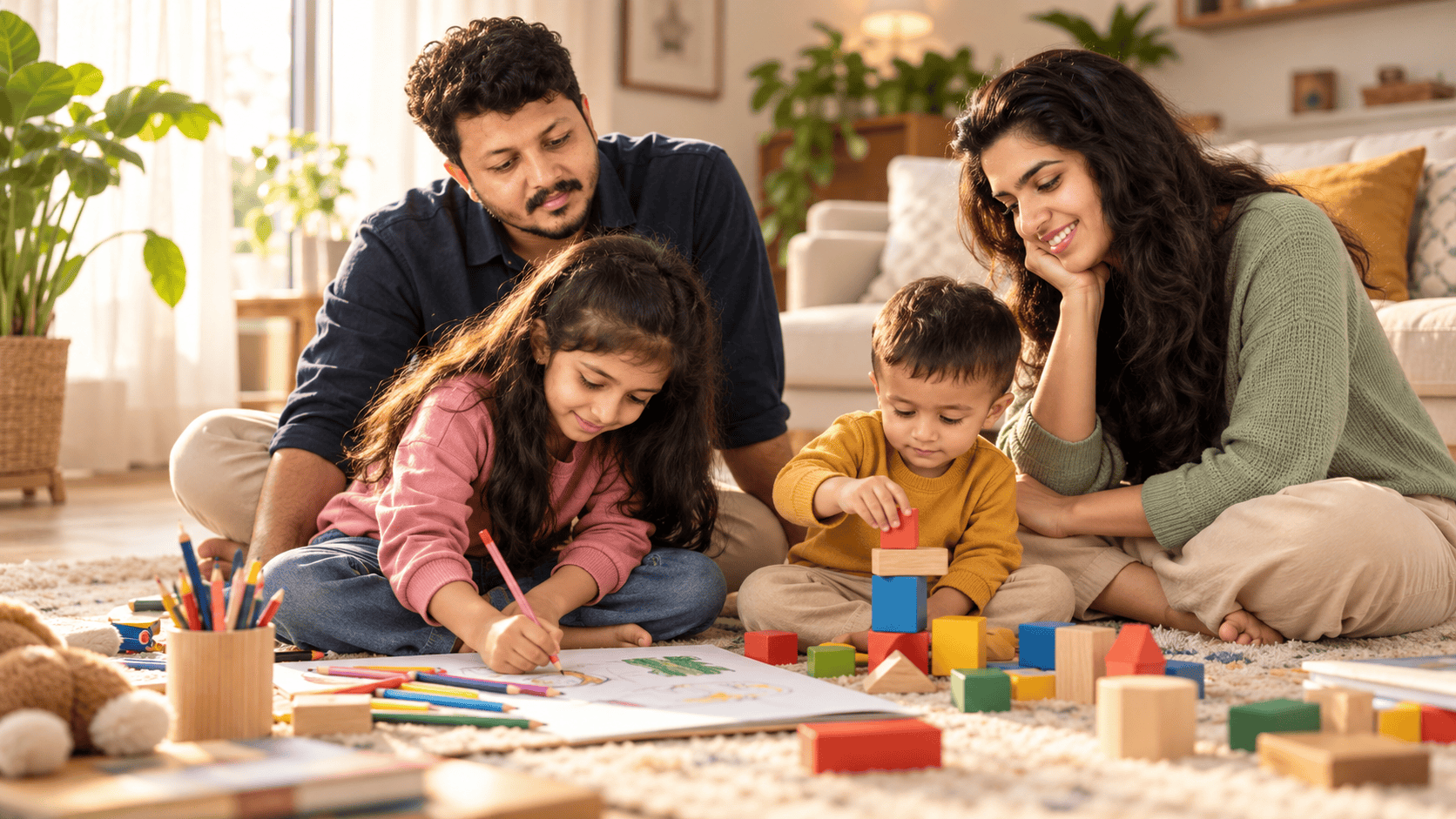
Learning objectives for kids can help parents and educators make activities purposeful, but does every moment of childhood need a measurable outcome? Discover how to balance structured learning with curiosity, play-based learning, creativity, and independent exploration.
Parents are often told to make learning intentional. Choose an activity, identify the skill it teaches, prepare the materials, and make sure your child learns something by the end. This approach can be useful, especially when children are developing foundational literacy, numeracy, language, cognitive, and motor skills. But what happens when every activity has a learning objective?
A drawing session becomes “fine motor practice.” A puzzle becomes “problem-solving development.” Storytime becomes “vocabulary building.” Even free play can start feeling like another lesson to complete.
The problem is not having learning objectives. The problem begins when we assume that every childhood experience needs a clearly defined educational outcome. Early learning works best when children have both purposeful experiences and room to explore, wonder, make mistakes, and discover things that adults did not plan for.
Why Are Learning Objectives Important for Kids?
Learning objectives give an activity direction. They help parents understand what a child might practise and help educators design experiences that are appropriate for a child's developmental stage. For example, a sorting activity may support early mathematical thinking, while storytelling can encourage vocabulary, listening, imagination, and communication.

ClassMonitor's approach reflects this balance. Its learning programs are designed around activity-based and child-centric learning, encouraging children to explore, investigate, observe, experience, think, and question. Its stated approach also includes self-paced learning, allowing children to understand, explore, revisit, and reinforce concepts at their own pace.
So the goal is not to remove objectives from learning. It is to avoid letting the objective become more important than the child's experience of learning.
What Happens When Every Activity Has a Learning Objective?
1. Learning Can Start Feeling Like a Checklist

When parents attach a specific outcome to every activity, it can become tempting to ask, “What did my child learn?” after everything they do.
A puzzle must improve problem-solving. Drawing must develop creativity. Blocks must teach spatial awareness. Reading must introduce new vocabulary.
These skills may genuinely develop through those experiences, but children do not always experience them as separate learning targets. They may simply be enjoying the puzzle, drawing a funny character, or building a tower.
That matters because learning through play is often valuable precisely because children are actively involved rather than completing a predetermined task. ClassMonitor's resources similarly combine puzzles, games, worksheets, flashcards, DIY activities, stories, and hands-on experiences across different learning areas.
2. Curiosity Can Get Replaced by Instructions

Imagine giving a child a bowl of leaves, stones, and twigs.
You could decide that the objective is classification and immediately instruct the child to sort everything by size.
Or you could simply ask, “What do you notice?”
The second approach may lead somewhere completely different. The child might notice colours, textures, insects, patterns, sounds, or shapes. They might create a pretend shop or build something with the materials.
There is still learning happening. It simply isn't entirely controlled by the adult.
For young children, curiosity and exploration can be important parts of the learning process. ClassMonitor's own guidance on encouraging toddler curiosity recommends giving children room to explore rather than providing every answer immediately.
3. Children May Start Looking for the “Right” Way to Play

When adults constantly explain what an activity is supposed to teach, children may begin to believe that there is a correct way to complete everything.
Consider building blocks. One child might build a tall tower, another might create a bridge, while another might abandon the blocks and turn them into pretend food.
If the adult's only goal is “build a stable structure,” some of that creative exploration disappears.
Open-ended activities allow children to make decisions, test ideas, change direction, and sometimes create something completely unexpected. That uncertainty is not a failure of the activity. It can be part of the learning.
4. Parents Can Miss the Learning That Wasn't Planned

One of the most interesting things about play-based learning is that the child may practise skills the adult never intended to teach.
A pretend restaurant might involve language, counting, social interaction, negotiation, imagination, memory, and problem-solving.
A simple board game might involve turn-taking, patience, communication, strategy, and handling disappointment.
A nature walk might become an exercise in observation, vocabulary, scientific thinking, and storytelling.
This is why learning objectives are best treated as guides rather than boundaries. The objective tells us what an activity can support; it does not necessarily tell us everything the child will learn.
What Are Better Ways to Use Learning Objectives?
Use Objectives to Design the Experience, Not Control It
A parent can start with an intention such as, “I want my child to practise counting.”
Instead of turning that into a formal lesson, count spoons while setting the table, count steps while walking, compare fruits at the market, or play a simple number game.
The objective remains useful, but the child experiences the learning as part of real life.
Ask Questions Instead of Giving Every Answer
Questions can keep children actively involved without turning play into a test.
Try asking, “What do you notice?” “What could we try?” “Why do you think that happened?” or “What else could we do?”
ClassMonitor's problem-solving resources similarly encourage parents to use questions rather than immediately placing the correct puzzle piece or providing the solution.
Leave Some Activities Completely Open-Ended
Not every activity needs a beginning, middle, and measurable end result.
Give children paper and crayons without asking them to draw a particular object. Offer blocks without showing them what to build. Put out household objects and let them decide how to use them.

These moments give children opportunities for creative thinking, independent learning, decision-making, and imagination.
Observe Before You Intervene
Sometimes the most useful thing a parent can do is watch.
What does your child choose first? What do they repeat? Where do they struggle? What makes them laugh? What do they try differently after something doesn't work?
Observation can reveal interests and emerging skills that a predetermined learning objective may not capture.
How Does Balanced Learning Benefit Children?
When structured learning and open-ended exploration coexist, children can develop a broader range of skills. Purposeful activities can support foundational concepts, while child-led experiences can encourage curiosity, creativity, problem-solving, communication, independence, and persistence.
This balance is particularly relevant in early childhood learning, when children are learning through many different kinds of experiences rather than through formal academic instruction alone. ClassMonitor describes its learning approach as holistic, combining areas such as literacy, numeracy, EVS, art and craft, role-play, music and movement, logical thinking, problem-solving, and social values.
The important question is therefore not, “Does this activity have a learning objective?”
A better question might be:
“What could my child discover through this experience?”
That small shift changes the parent's role from directing every outcome to creating meaningful opportunities for learning.
Expert Tips for Parents
Have an intention, but stay flexible. Know what a child might practise, but allow the activity to evolve naturally.
Don't turn every question into a quiz. Sometimes “I wonder too” can encourage more exploration than immediately providing the answer.
Let children change the rules occasionally. Their variations can reveal creativity, reasoning, and independent thinking.
Celebrate discovery, not just completion. “You found another way!” can be more meaningful than simply saying, “Good job.”
Protect unstructured play. Children need time when they can decide what to do without an adult-defined learning target.
How ClassMonitor Approaches Meaningful Learning
At ClassMonitor, learning is built around activity-based, child-centric, hands-on experiences designed to make learning engaging rather than purely instructional. Its learning materials include puzzles, games, worksheets, flashcards, DIY activities, stories, and other resources that support different developmental areas.
The bigger idea is simple: an activity can have a purpose without becoming a test.
A child can learn while playing, questioning, experimenting, imagining, creating, and sometimes doing something completely different from what the adult expected.
And perhaps that is one of the most important objectives of all: helping children become curious enough to keep learning.
Recommended ClassMonitor Reads
For parents who want to explore playful and purposeful learning further, read Problem-Solving Skills for Kids for practical ways to turn everyday challenges into opportunities for thinking and discovery.
You can also explore 20+ Easy STEM Activities for Kids at Home for hands-on activities that connect curiosity with scientific thinking and problem-solving.
For ideas around curiosity-led learning, How to Encourage Your Toddler's Curiosity explores how parents can give children space to explore rather than providing every answer.

FAQs
1. What are learning objectives for kids?
Learning objectives describe the skills or concepts an activity is intended to support, such as language, numeracy, problem-solving, creativity, or fine motor development. They can help parents and educators plan purposeful learning experiences.
2. Does every children's activity need a learning objective?
No. Learning objectives can be useful for structured activities, but children also benefit from open-ended play, exploration, imagination, and self-directed experiences.
3. Is play-based learning still educational?
Yes. Play can provide opportunities for children to practise communication, problem-solving, creativity, decision-making, social skills, and other developmental abilities. ClassMonitor uses activity-based learning across areas including literacy, numeracy, creativity, and logical thinking.
4. How can parents make learning more interesting?
Parents can connect learning with everyday experiences, ask open-ended questions, provide hands-on materials, follow the child's interests, and allow children to make choices during activities.
5. Should parents correct children during every learning activity?
Not necessarily. Giving children time to think, experiment, and make manageable mistakes can encourage independent problem-solving and deeper engagement.
6. What is the difference between structured learning and open-ended play?
Structured learning usually has a defined goal, instructions, or expected outcome. Open-ended play gives children more freedom to decide what they do, how they use materials, and where the experience leads.
Learning objectives for kids are valuable when they help adults create meaningful experiences, but they should not turn childhood into a series of lessons with boxes to tick.
Sometimes the child who spends twenty minutes building something that was never part of the plan is learning exactly what they need: how to wonder, experiment, make choices, solve problems, and keep going.
Purposeful learning matters. So does the freedom to discover.


