
Best Age to Start Mental Math for Children | Parent's Complete Guide
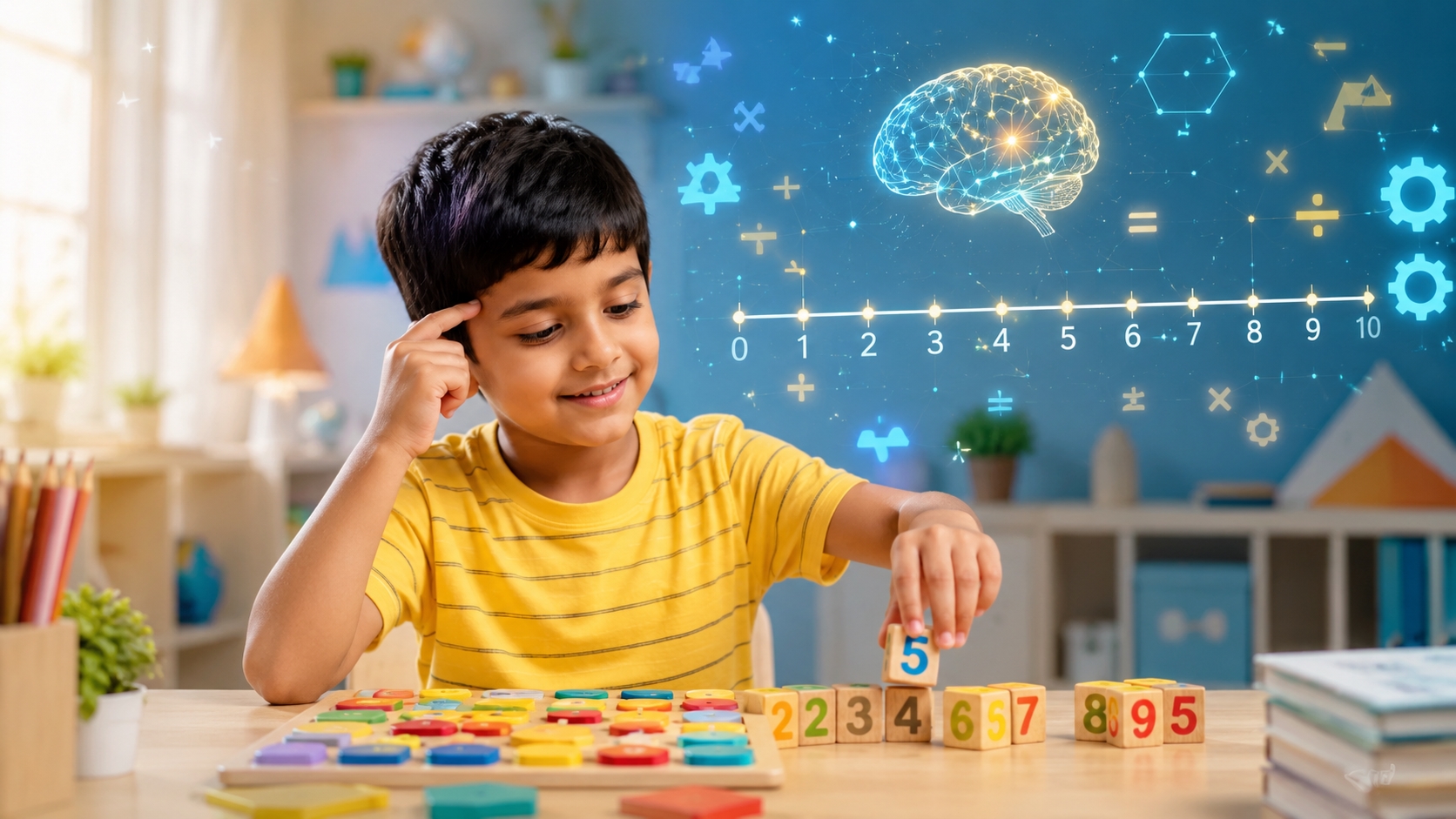
Best Age to Start Mental Math for Children: A Parent’s Complete Guide
The best age to start mental math for children is between 5 and 7 years, when they develop a basic understanding of numbers and arithmetic. However, the foundation for mental math begins much earlier through counting, sorting, pattern recognition, and everyday play. Introducing age-appropriate activities helps children build strong number sense, confidence, and problem-solving skills that support lifelong mathematical learning.
Best Age to Start Mental Math for Children: A Parent’s Complete Guide
Every parent wants their child to enjoy learning and succeed in school. While reading and language skills often receive a lot of attention during the early years, mathematics is just as important. One question many parents ask is, "What is the right age to start mental math?"
Some parents worry about introducing it too early, while others fear they may have started too late. The truth is that mental math isn't about memorizing complicated calculations at a young age. Instead, it's about helping children understand numbers, recognize patterns, and solve simple problems using logical thinking.
Mental math is a gradual skill that develops over time. Long before children learn addition or multiplication, they begin building the foundation through everyday experiences like counting toys, comparing objects, recognizing shapes, and noticing patterns. When these experiences are playful and age-appropriate, children naturally develop confidence with numbers.
In this guide, we'll explore the best age to introduce mental math, how children's mathematical thinking develops at different stages, signs your child is ready, fun activities to practice at home, and common mistakes parents should avoid.
What Is Mental Math?
Mental math is the ability to solve mathematical problems without using paper, calculators, or other tools. Instead of memorizing answers, children learn to think about numbers, understand relationships between them, and use different strategies to solve problems in their minds.
For example, instead of writing down 36 + 29, a child may think:
- 36 + 30 = 66
- 66 – 1 = 65
This flexible approach develops strong number sense and makes advanced mathematical concepts easier to understand later.
Mental math isn't about solving problems as quickly as possible. It's about understanding numbers and developing confidence in mathematical thinking.
Why the Right Age Matters
Children learn best when activities match their stage of development. Just as toddlers aren't expected to read full sentences, they also aren't ready for formal mental calculations. However, they can build the skills that prepare them for future success.
Choosing the right age doesn't mean waiting until school begins. It means providing experiences that match your child's current abilities and curiosity. Age-appropriate activities reduce frustration, increase confidence, and help children develop a positive attitude toward mathematics.

Mental Math Development by Age
Ages 2–3: Building Early Number Awareness
Children between two and three years are naturally curious about the world around them. Although they aren't ready for calculations, they begin developing early mathematical thinking.
At this stage, encourage activities such as:
- Counting toys
- Matching shapes
- Sorting objects by color or size
- Recognizing simple patterns
- Comparing "more" and "less"
For example, while playing, ask:
"Can you give me three blocks?"
or
"Which basket has more apples?"
These simple conversations introduce mathematical concepts naturally without making learning feel like a lesson.
Ages 3–5: Creating a Strong Foundation
Preschoolers begin recognizing numbers, counting confidently, and understanding basic quantities. This is an excellent stage to introduce math through games rather than worksheets.
Children enjoy:
- Number puzzles
- Dice games
- Counting while climbing stairs
- Shape hunts
- Building blocks
- Number storybooks
Instead of asking them to memorize answers, encourage them to explain their thinking. This develops reasoning skills that are essential for future mental math.
Ages 5–7: The Ideal Age to Start Structured Mental Math
Most educators consider 5 to 7 years the best age to introduce structured mental math.
By this stage, children usually understand:
- Basic addition
- Basic subtraction
- Counting forwards and backwards
- Number bonds
- Simple place value
Now they can begin learning mental strategies such as:
- Breaking numbers apart
- Skip counting
- Estimation
- Making friendly numbers
- Recognizing patterns
For example:
Instead of solving 48 + 27 the traditional way, children may think:
48 + 20 = 68
68 + 7 = 75
These flexible strategies improve both speed and understanding.
Ages 8–10: Strengthening Mental Math Skills
If your child is older, don't worry. Mental math can still be learned successfully.
Children at this age are ready for:
- Multiplication
- Division
- Fractions
- Decimals
- Percentages
- Multi-step calculations
Their improved reasoning abilities often help them understand advanced strategies more quickly.

Signs Your Child Is Ready for Mental Math
Every child develops differently, but these signs suggest they may be ready to begin:
- Recognizes numbers confidently
- Counts objects accurately
- Enjoys puzzles and games
- Notices patterns
- Understands simple comparisons
- Follows instructions
- Shows curiosity about numbers
- Enjoys solving little challenges
Remember, readiness is more important than age.
Benefits of Starting Mental Math at the Right Time
1. Builds Strong Number Sense
Children understand how numbers relate to one another instead of memorizing facts.
2. Improves Problem-Solving Skills
Mental math encourages flexible thinking and helps children find multiple ways to solve the same problem.
3. Boosts Confidence
When children solve problems independently, they begin believing in their own abilities.
4. Strengthens Memory and Concentration
Mental calculations improve working memory, attention span, and focus.
5. Makes School Math Easier
Children with good mental math skills understand new mathematical concepts more easily and perform better in class.
6. Encourages Logical Thinking
Children learn to analyze problems, estimate answers, and check whether their solutions make sense.
7. Develops Real-Life Math Skills
Mental math is useful for:
- Shopping
- Cooking
- Measuring
- Time management
- Sharing objects equally
- Keeping score during games
8. Reduces Math Anxiety
When mathematics is introduced through play and exploration, children are less likely to develop fear or frustration.
10 Fun Mental Math Activities Parents Can Try at Home
Count Everyday Objects
Count fruits, toys, books, or steps together and ask simple addition or subtraction questions.
Grocery Shopping Games
Ask questions like:
- Which costs more?
- What happens if we buy two?
- Which item is cheaper?
Cooking Together
Measuring ingredients introduces counting, fractions, and estimation naturally.
Dice Games
Roll two dice and ask children to add, subtract, or compare numbers.
Number Treasure Hunt
Hide number cards around the house and ask children to arrange them in order or identify even and odd numbers.
Flashcard Challenges
Encourage children to explain how they found the answer rather than simply saying it.
Estimation Games
Ask:
- How many pencils are in this jar?
- Which container holds more?
Board Games
Many family board games naturally involve counting, planning, and simple calculations.
Pattern Building
Use beads or blocks to create patterns and ask children what comes next.
Daily Number Talk
Spend five minutes discussing simple math questions during meals or car rides.
Common Mistakes Parents Should Avoid
Helping children develop mental math doesn't require pressure or long study sessions.
Avoid these common mistakes:
- Starting formal calculations too early
- Focusing only on speed
- Comparing children with others
- Correcting every mistake immediately
- Depending too much on calculators
- Turning practice into long lessons
Instead, keep activities short, playful, and encouraging.
Why Play-Based Learning Works Best
Young children learn best through play because it keeps them engaged and curious. Games, puzzles, stories, and hands-on activities help children understand mathematical concepts naturally.
Play-based learning encourages:
- Creativity
- Critical thinking
- Problem-solving
- Communication
- Confidence
Instead of memorizing answers, children develop genuine mathematical understanding that lasts throughout their education.
How ClassMonitor Supports Mental Math Learning
At ClassMonitor, we believe mathematics should be exciting, meaningful, and enjoyable. Our learning approach combines educational games, activity kits, puzzles, worksheets, and hands-on experiences designed by early childhood experts.
Children explore numbers through interactive activities that encourage logical thinking, creativity, and confidence rather than rote memorization. By making learning playful and engaging, ClassMonitor helps children build strong mathematical foundations that prepare them for school and everyday life.

Frequently Asked Questions
What is the best age to start mental math?
Most children are ready for structured mental math between 5 and 7 years, although foundational skills begin much earlier through everyday play.
Can preschoolers learn mental math?
Preschoolers can develop number sense through counting, sorting, matching, and pattern activities, even though they aren't ready for formal calculations.
Is 8 years too late to start mental math?
No. Children can successfully develop mental math skills at almost any age with consistent practice and age-appropriate strategies.
How can parents teach mental math at home?
Parents can use games, puzzles, cooking, shopping, counting everyday objects, and short number conversations to build mental math naturally.
Does mental math improve academic performance?
Yes. Mental math strengthens problem-solving, memory, logical thinking, concentration, and confidence, which support success across many school subjects.
Conclusion
The best age to start mental math isn't determined by a specific birthday but by a child's readiness and developmental stage. While structured mental math is typically introduced between 5 and 7 years, the journey begins much earlier through playful experiences that build number sense and curiosity. By encouraging counting, patterns, puzzles, and everyday math conversations, parents can help children develop confidence and a positive relationship with mathematics. Most importantly, mental math should never feel like pressure—it should be a fun and rewarding part of everyday learning. With the right support, children can build lifelong mathematical skills that help them succeed both in school and beyond.